An anti-slavery ancestor…

This post continues the story of James Hubsdell, my great-great-great-grandfather who enlisted in the Royal Navy in 1821. He served on three ships during his 10-year service – the Chanticleer, the Atholl and the Blonde. My previous post told of his time with the Chanticleer.

This time I will describe his action-packed time on the Atholl.

hms athollThe Atholl-class corvettes were a series of fourteen Royal Navy sixth-rate post ships built to an 1817 design by the Surveyors of the Navy. HMS Atholl, the first of the type, was built at Woolwich Dockyard. Ordered on 27 October 1816, she was laid down in November 1818, launched on 23 November 1820 and entered service on 9 February 1821.

When James Hubsdell joined her, as a sail-maker, on 6 Oct 1824 she was at Portsmouth.

From there she set off to join the West Africa Squadron based out of Freetown Sierra Leone.

So what was the West Africa Squadron?
In 1807 the British Parliament passed a bill prohibiting the slave trade. The act did nothing to end slavery within the nation’s borders, but did prohibit the overseas transportation and trade in slaves. To enforce the law, Britain patrolled the seas off the coast of Africa, stopping suspected slave traders and confiscating the ship when slaves were found. The human cargo was then transported back to Africa.

By 1818 the squadron had grown to six ships with a naval station established in 1819 at what is now Freetown and a supply base at Ascension Island, later moved to Cape Town in 1832.

The resources were further increased; in the middle of the 19th century there were around 25 vessels and 2,000 personnel with a further 1,000 local sailors. Between 1808 and 1860 the West Africa Squadron captured 1,600 slave ships and freed 150,000 Africans.

Intercepting Slavers…

When the Atholl arrived on station off the West African Coast she immediately began to intercept suspected slave ships and the record of some of these actions survives in detail:

“7 Mar 1825, detained in lat. 5° 21′ N., long. 13° 13′ W., in the River Gallinas, the Spanish slave schooner Espanola, Francisco Ramon Roderiguez, Master, 270 slaves on board when detained, which was sent for adjudication to the British and Spanish Mixed Court of Justice, Sierra Leone, and sentenced to be condemned.

1 Sep 1825, detained in lat. 4° 12′ N. long. 5° 33′ W., off Cape Formosa, when bound from St. Thomas in the West Indies to the West Coast of Africa the Dutch slave schooner Venus, Andre Desbarbes, Master, which was sent for adjudication to the British and Netherlands Mixed Court of Justice, Sierra Leone and on 23 Sep 1825 sentenced to be condemned.

9 Sep 1825 the when in company with the Esk and Redwing, detained in lat. 2° 23′ N. long. 4° 17′ E., the Portuguese slave schooner Uniao, Jozé Ramos Gomis, Master, which was sent for adjudication to the British and Portuguese Court of Mixed Commission, Sierra Leone, and 21 Oct 1825 sentenced to be condemned.”

The Uniao was a notorious slaver that had made numerous runs across the Atlantic. After interception, the slaves being carried aboard were all listed and the first page of the list from the Uniao comprises entirely children.
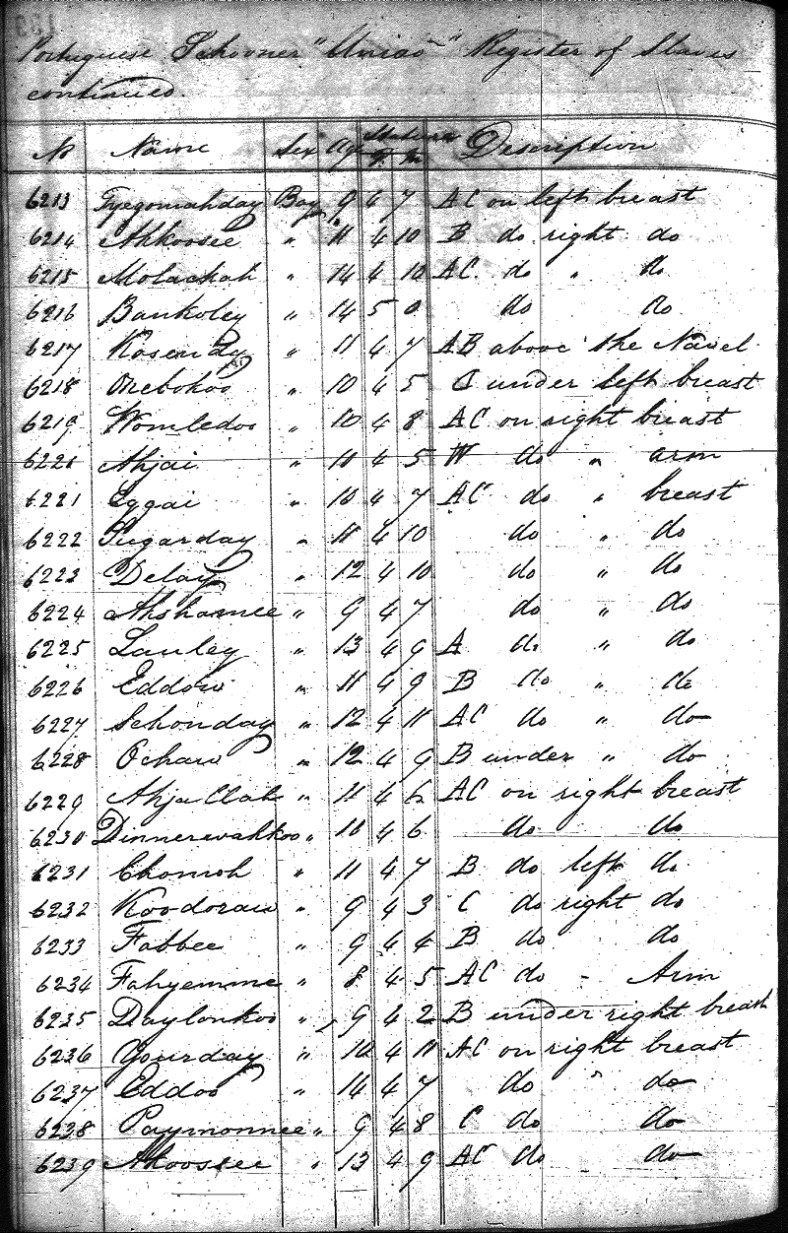
uniao roster

The Atholl’s busy time on the African coast continued:

“15 Sep 1825 departed Prince’s Island in company with the Maidstone, Esk, Redwing and Conflict, who departed in execution of their various orders.

17 Oct 1825, detained off Whydah, the slave brig George and James, whch was sent for adjudication to the Vice-Admiralty Court and sentenced to be condemned.

11 Nov 1825 boarded the Activo off Elmina.

12 Nov 1825, detained off Elmina Castle, the Dutch slave schooner Amable Claudina, Claudio Picaluga, Master, with 36 slaves on board when detained, which was sent for adjudication to the British and Netherlands Mixed Court of Justice, Sierra Leone and sentenced to be condemned.

25 Nov 1825, detained in lat. 3° 31′ N. long. 0° 54′ E., when bound from Lagos to Bahia the Brazilian slave brigantine San Joao Segunda Rosalia, the late Amara Joze da Silva, Master, with 258 slaves on board when detained, 72 of whom died on the passage up to Sierra Leone. Was sent for adjudication to the British and Portuguese Court of Mixed Commission, Sierra Leone, and was condemned on 9 Feb 1826.”

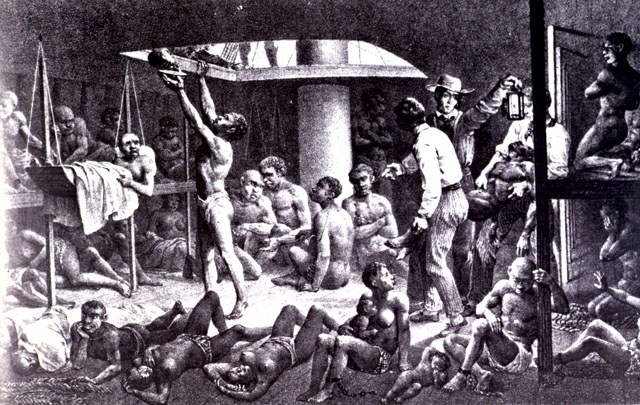
As an indication of the type of experience these bare facts describe, I thought I would include a couple of illustrations.

Below is a drawing of a slave ship detained in 1822, around the time of the Atholl’s patrols, showing how the slaves were housed:

slave ship vigilante 1822

The following excerpts are from an account by the Reverend Robert Walsh who served aboard one of the ships assigned to intercept the slavers off the African coast. On the morning of May 22, 1829, a suspected slaver was sighted and the naval vessel gave chase. The next day, a favorable wind allowed the interceptor to gain on its quarry and approach close enough to fire two shots across her bow. The slaver heaved to and an armed party from the interceptor scrambled aboard her. We join Reverend Walsh’s account as he boards the slave ship:

“When we mounted her decks we found her full of slaves. She was called the Feloz, commanded by Captain Jose’ Barbosa, bound to Bahia. She had taken in, on the coast of Africa, 336 males and 226 females, making in all 562, and had been out seventeen days, during which she had thrown overboard 55. The slaves were all enclosed under grated hatchways between decks. The space was so low that they sat between each other’s legs and were stowed so close together that there was no possibility of their lying down or at all changing their position by night or day. As they belonged to and were shipped on account of different individuals, they were all branded like sheep with the owner’s marks of different forms. These were impressed under their breasts or on their arms, and, as the mate informed me with perfect indifference ‘burnt with the red-hot iron’…

But the circumstance which struck us most forcibly was how it was possible for such a number of human beings to exist, packed up and wedged together as tight as they could cram, in low cells three feet high, the greater part of which, except that immediately under the grated hatchways, was shut out from light or air, and this when the thermometer, exposed to the open sky, was standing in the shade, on our deck, at 89 degrees. The space between decks was divided into two compartments 3 feet 3 inches high; the size of one was 16 feet by 18 and of the other 40 by 21; into the first were crammed the women and girls, into the second the men and boys: 226 fellow creatures were thus thrust into one space 288 feet square and 336 into another space 800 feet square, giving to the whole an average Of 23 inches and to each of the women not more than 13 inches…

It was not surprising that they should have endured much sickness and loss of life in their short passage. They had sailed from the coast of Africa on the 7th of May and had been out but seventeen days, and they had thrown overboard no less than fifty-five, who had died of dysentery and other complaints in that space of time, though they had left the coast in good health. Indeed, many of the survivors were seen lying about the decks in the last stage of emaciation and in a state of filth and misery not to be looked at…
While expressing my horror at what I saw and exclaiming against the state of this vessel for conveying human beings, I was informed by my friends, who had passed so long a time on the coast of Africa and visited so many ships, that this was one of the best they had seen. The height sometimes between decks was only eighteen inches, so that the unfortunate beings could not turn round or even on their sides, the elevation being less than the breadth of their shoulders; and here they are usually chained to the decks by the neck and legs. In such a place the sense of misery and suffocation is so great that the Negroes, like the English in the Black Hole at Calcutta, are driven to a frenzy…”

But even if such vessels were intercepted, their fate was still not certain as the last example from the Atholl’s log shows.

“1 Feb 1826, detained in Lat. 4° 24′ S. Long. 9° 37’ W., en route from Badagry to Pernambuco, the Brazilian slave brig Activo, 149 tons, José Pinto de Araujo, Master, with 166 slaves on board when detained, 2 of whom died on the passage up to Sierra Leone, which was sent for adjudication to the British and Portuguese Court of Mixed Commission, Sierra Leone on 17 Feb 1826 which was subsequently restored to her master, having been detained south of the Equator, despite the fact that the slaves were embarked north of that line.”

This last case shows how ridiculously complicated the rules were around slave trading during this period when different countries were gradually tightening their rules on the trade – the trade south of the equator was deemed still to be legitimate as Brazil had not signed up to any agreements and their trade was off limits to the Navy’s blockade. As a result of the inquiry into the capture of the Activo, Captain Murray of HMS Atholl was ordered by the court to pay the slavers over £11,000 compensation, the equivalent of  £1.2m today.

Shortly after this episode, the Atholl was detached from the West Africa Squadron and sent to the East Indies on diplomatic and anti-piracy duties. She was recorded as being in Madras on 29 May 1826 before departing for Rangoon on 14 June. It wasn’t until early 1827 that she set sail for home.

James Hubsdell left the ship in October 1827 and joined HMS Blonde the following year. But that is for another post.
The Chanticleer

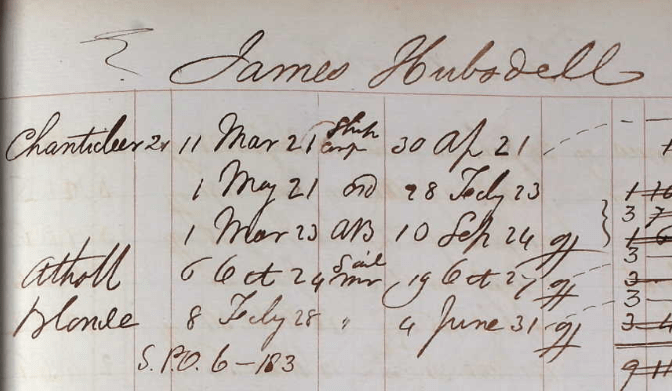
James Hubsdell was my great-great-great-grandfather, born in about 1800 in Gosport who enlisted in the Royal Navy in 1821. He served on three ships during his 10-year service – the Chanticleer, the Atholl and the Blonde – as shown in his service record.

james hubsdell service record

During his time with each vessel it seems like he must have seen some “interesting” service and the first was HMS Chanticleer.

HMS Chanticleer was a Cherokee-class 10-gun brig and was launched on 26 July 1808. She served in European waters (mainly the North Sea) during the Napoleonic Wars and was paid off and laid up at Sheerness in July 1816 at the end of those wars. It is unclear when she was brought back into service but on 23 October 1821 Captain Henry Eden took command. He sailed her to the Mediterranean, where he was “very efficiently occupied during the revolution in Greece.”

Commander Burton MacNamara replaced him in July 1822 and for the next two years the ship was employed in a number of mostly diplomatic missions around the Mediterranean.

During that time her ship’s surgeon William Black wrote an account of the cruises and illustrated it himself. The following is from his book:

chanticleer

Chanticleer in the Port of Pireus, Athens

When piracy out of Algiers recommenced under Huseyn Dey the Chanticleer was sent to join the fleet under the command of Admiral Sir Harry Neal which bombarded Algiers. This action was notable as the first recorded use of a steam ship in action.

Shortly afterwards, Charles James Hope Johnstone took command of the Chanticleer in September 1824 when my ancestor transferred to the Atholl, bound for the west coast of Africa….

…the subject of a separate post.

A catechism of Terror…

robespierre_cropMaximilien Robespierre, the architect of the Terror during the French Revolution in which the state killed tens of thousands of its own people, penned his own catechism of Terror on the eve of coming to power in 1793. Like the Catholic catechism it mocked, it was structured in the form of questions and answers.

The central section concerned overcoming the “ignorance” of the common people.

Question: What are the obstacles to their enlightenment?
Answer: The paid journalists who mislead the people everyday by shameless distortions.
Question: What conclusion follows?
Answer: That we ought to proscribe these writers as the most dangerous enemies of the country…

trump_angryDuring his presidential campaign, candidate Donald Trump pursued a systematic policy of disparaging the mainstream media. Since becoming President his attacks have become more specific and vitriolic.

On 17 Feb 2017 he Tweeted the following:

“The FAKE NEWS media (failing @nytimes, @NBCNews, @ABC, @CBS, @CNN) is not my enemy, it is the enemy of the American People!”

I may be mistaken but I doubt if Trump or his advisers have read Robespierre’s catechism of Terror. Maybe they have read the work of Friedrich and Brzezinski who, in the 20th century, formalised the defining characteristics of totalitarianism, I don’t know. But one of the six defining characteristics they list is the control of the means of communication.

People argue about whether or not we can learn anything from history.

Well it’s about time America woke up and smelled the coffee.

A naïve and sentimental super-hero…

(c) Government Art Collection; Supplied by The Public Catalogue Foundation

Thomas Cochrane became one of the most celebrated naval heroes of his day. Napoleon dubbed him Le Loup des Mers (literally ‘The Wolf of the Seas’) and his career inspired C.S. Forrester’s fictional hero Horatio Hornblower and Patrick O’Brien’s Jack Aubrey. He was an inspiring leader and innovator, yet his political naivety and radical outspokenness almost cost him everything.

Thomas Cochrane was born at Annsfield, near Hamilton, in Scotland in 1775, the son of Archibald Cochrane, 9th Earl of Dundonald. He joined the navy at the age of 17 on the outbreak of the French Revolutionary Wars in 1793 as a midshipman serving in HMS Hind, a frigate commanded by his uncle, Captain Alexander Cochrane.

In less than three years Cochrane was promoted lieutenant and then in 1800 promoted to commander, taking command of the brig-sloop HMS Speedy later that year. In his 13-month cruise aboard the Speedy, Cochrane captured, destroyed or drove onshore over 50 enemy vessels. His most notable exploit was the capture of the Spanish xebec frigate El Gamo, on 6 May 1801. El Gamo carried 32 guns and 319 men, compared with Speedy’s 14 guns and 54 men. Cochrane flew an American flag and approached so closely to El Gamo that its guns could not depress to fire on the Speedy’s hull. The Spanish tried to board and take over the ship but each time they massed to attack, Cochrane pulled away briefly and fired on the concentrated boarding parties with his ship’s guns. Eventually, Cochrane boarded El Gamo, despite being outnumbered about five to one, and captured her.

Capture_of_the_El_Gamo

HMS Speedy captures the frigate El Gamo

Given command of the new frigate HMS Pallas (32) in 1804, he cruised the Azores and French coast capturing and destroying several Spanish and French vessels. Transferred to HMS Imperieuse (38) in August 1806, he returned to terrorizing the French coast. Now a master of coastal warfare, Cochrane frequently led cutting out missions to seize enemy ships and captured French coastal installations.

But in 1809, his star came crashing down.

At the Battle of the Basque Roads in April of that year, Cochrane’s initial attack using fire ships greatly disrupted the French fleet. But his commander, Lord Gambier, failed to effectively follow up to completely destroy the enemy. Elected to Parliament in 1806, Cochrane had sided with the Radicals and frequently criticized the prosecution of the war and campaigned against corruption in the Royal Navy. These efforts had lengthened his list of enemies in higher office. Publically criticizing Gambier in the wake of Basque Roads, he alienated many more senior members of the Admiralty. Their retribution was swift and Cochrane was removed from his command and denied any other. Though loved by the public, he became isolated in Parliament as he angered his peers with his outspoken views.

In 1814, his fall was made humiliatingly complete. Cochrane was implicated in a stock market fraud based on the rise of government stock following false rumours of Napoleon’s death. In June with five others he was brought to trial for fraud in a trial presided over by the harsh, overbearing and Radical-hating Lord Ellenborough. The outcome was never going to be in question and, even though the prosecuting counsel admitted the evidence was circumstantial, Cochrane was found guilty.

Cochrane_Stock_Exchange

An 1815 caricature “Things as they have been. Things as they are now.” depicting Cochrane as the naval hero on the left while the right side shows him as the disgraced and imprisoned civilian

Cochrane was sentenced to 12 months imprisonment, fined £1,000 and was ordered to stand in the pillory opposite the Royal Exchange for one hour. In subsequent weeks, he was dismissed from the Royal Navy by the Admiralty and expelled from Parliament following a motion in the House of Commons. Cochrane was further humiliated by the loss of his knighthood in a degradation ceremony at Westminster Abbey. His banner was taken down from the Chapel of Henry VII in the Abbey and physically kicked out of the chapel and down the steps outside.

Persona non grata in his own country, Cochrane elected to sell his military services overseas. He went on to command the Chilean, Brazilian and Greek navies, helping them fight for independence. In 1831 he succeeded to his father’s title, becoming 10th Earl of Dundonald.

Returning to Britain, Cochrane was finally pardoned in May 1832 at a meeting of the Privy Council. Though restored to the Navy List with a promotion to rear admiral, he refused to accept a command until his knighthood was returned. This did not occur until Queen Victoria reinstated him as a knight in the Order of Bath in 1847. Now a vice admiral, Cochrane served as commander in chief of the North American and West Indies station from 1848-1851. Promoted to admiral in 1851, he was given the honorary title of Rear Admiral of the United Kingdom three years later. Troubled by kidney stones, he died during an operation on October 31, 1860.

Cochrane was buried in the central part of the nave of Westminster Abbey. The inscription, written on his tomb by Sir Lyon Playfair, reads:

“HERE RESTS IN HIS 85th YEAR THOMAS COCHRANE TENTH EARL OF DUNDONALD BARON COCHRANE OF DUNDONALD OF PAISLEY AND OF OCHILTREE IN THE PEERAGE OF SCOTLAND MARQUESS OF MARANHAM IN THE EMPIRE OF BRAZIL G.C.B. AND ADMIRAL OF THE FLEET WHO BY THE CONFIDENCE WHICH HIS GENIUS HIS SCIENCE AND EXTRAORDINARY DARING INSPIRED, BY HIS HEROIC EXERTIONS IN THE CAUSE OF FREEDOM AND HIS SPLENDID SERVICES ALIKE TO HIS OWN COUNTRY GREECE BRAZIL CHILI AND PERU ACHIEVED A NAME ILLUSTRIOUS THROUGHOUT THE WORLD FOR COURAGE PATRIOTISM AND CHIVALRY. BORN DEC 14th 1775. DIED OCT. 31st 1860”

Agustina get your gun…

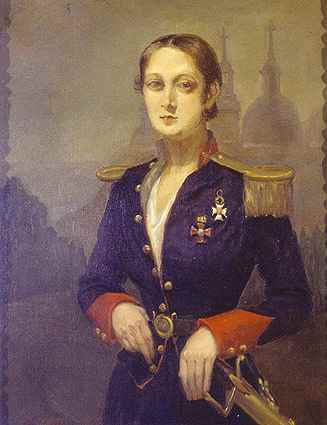
Agustina_de_aragon4redAgustina Raimunda María Saragossa Domènech was just 18 years old when she found herself besieged in the northern Spanish city of Zaragoza in the summer of 1808. Though the city had not seen war for 450 years, the population rose up with much of the rest of the country as part of the Dos de Mayo (2 May) uprising against the French who had seized power in Spain and replaced the rightful monarch with Napoleon’s brother Joseph Bonaparte. The rising was mostly quickly and brutally suppressed but Zaragoza held out and Marshal Bessieres, in command of French forces in north east Spain, detached General Lefebvre-Desnouettes with 6000 troops to take the city.
Their first assault was bloodily repulsed but the French were reinforced by 3000 more troops under General Verdier who, being senior to Lefebvre, took command. The second assault on 2 July was more determined and breached the Portillo, an ancient gateway into the city defended by a hodgepodge battery of old cannons and a heavily outnumbered volunteer unit. Agustina’s lover was an artillery sergeant in this unit and she was delivering food to him when she was caught up in the attack.
The story then merges into myth. The Spanish defenders were wavering under the onslaught. Agustina’s lover and his gun crew had been killed before they could fire off their last round. It is said that the young woman ran forward, snatched the lighted match from her dead lover’s hand and fired the cannon. The leading French attackers, hit by grapeshot at point blank range were mown down, the Spanish defenders rallied and the attack was thrown back.
Fierce fighting continued for a few days then dragged on inconclusively for three more weeks before the French abandoned the siege. Though they would be back.
In December of the same year the French returned. Initially under the command of General Junot, the French progressed slowly but in January 1809 command was taken over by Marshal Lannes, one Napoleon’s most competent marshals. He accelerated the attack. The walls were breached at the end of January but rather than surrender, the defenders set about defending the city street by street.
agustina aragonPestilence broke out in the city and by the 19 February the Spanish commander, José de Palafox, sued for surrender. The defence had cost the lives of approximately 20000 soldiers and 35000 civilians. The French lost close on 10000 men, more than half to sickness. The city was a devastated wreck.
Agustina was captured, her baby child killed. But subsequently she mounted a daring escape from captivity and became the leader of a guerrilla band organising harassing raids and attacks on the French occupying army. As the strategic situation deteriorated for the French Army, her role became increasingly orthodox as supplies and training were covertly provided by the Duke of Wellington.
agustina goyaBy now the legend of Agustina of Aragón was folklore.
After the war, she married a doctor and, late in life, she became a familiar sight in Zaragoza as a respectable old lady, wearing medals, who used to go for walks around the Portillo. Agustina died at the age of 71 in Ceuta.
Agustina-de-Aragon-tt0042185-1950-Peris-Arago-es-0Agustina’s heroism became a popular subject for artists both contemporary and later. The only truly identifiable person in Goya’s “The Disasters of War” is Agustina firing her cannon. Modern culture too wouldn’t let go of the legend. Her story was one of the first subject of silent film in Spain when the epic “Agustina of Aragon” was released in 1929. It was followed by a remake in 1950.

Twenty thousand leagues (ok, 20 feet) under the sea…

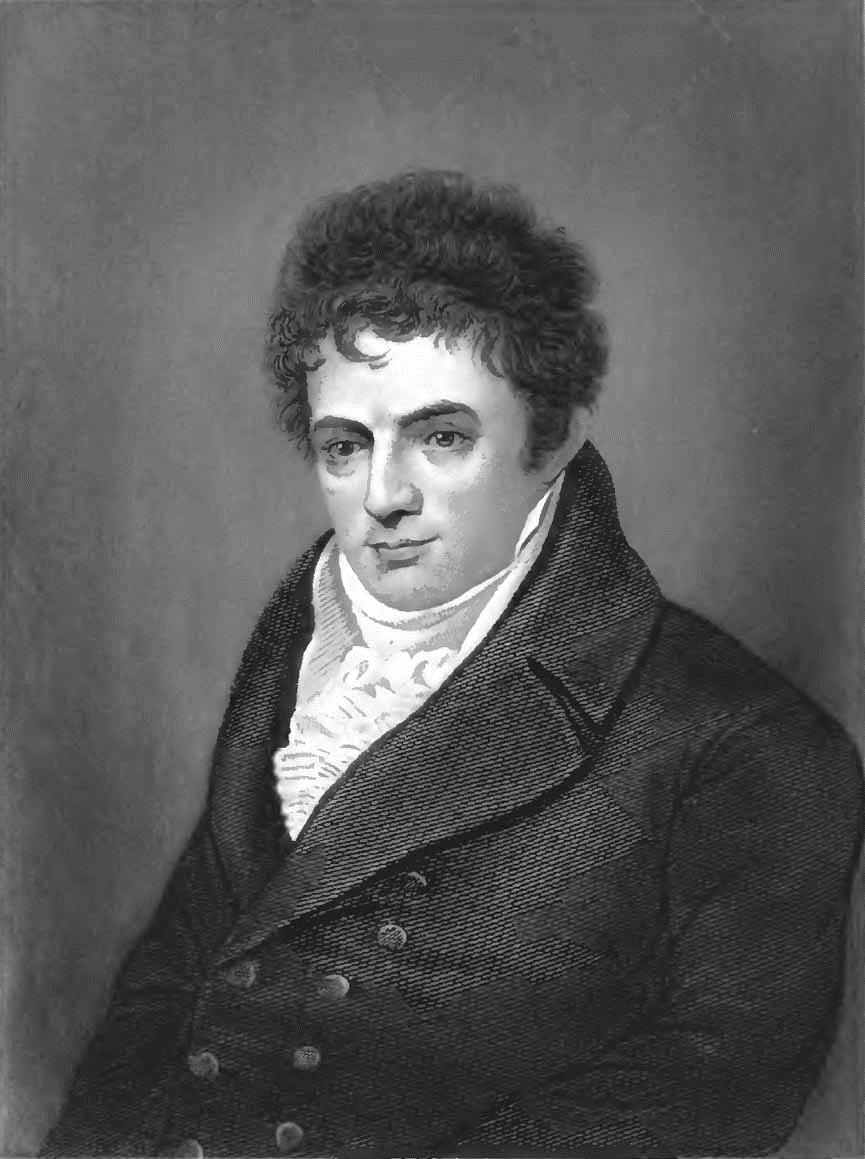
portrait-engraving-of-robert-fulton-steamboat-innovatorRobert Fulton was an American engineer and inventor who is widely credited with developing the world’s first commercially successful steamboat in 1807 that plied a route between New York City and Albany. However, it is his earlier adventures with prototype submarine warfare that I am making the subject of this post.

In the mid 1790s he went to Paris where his reputation as an inventor was already known and petitioned the French government to support his design for “a machine which flatters me with much hope of being able to annihilate their [England’s] Navy.” That machine was a submarine.

fultonjmnautIn Fulton’s design the submarine would tow an underwater bomb (which he called a torpedo) to be planted under enemy vessels. The initial response was positive and after some negotiations, the American inventor delivered a detailed plan for a vessel he baptized the “Nautilus”. However, before construction began, the Minister of Marine cancelled the project. A year later, after a change of minister, Fulton pressed again and a specially appointed commission examined his designs and recommended proceeding with the construction of the submarine. However, the government still prevaricated.

After the coup of 18 Brumaire, which elevated Napoleon to power, Fulton decided to insist one more time. In 1800, he sent a letter to the Minister of Marine with a proposal to build the Nautilus. The American inventor was convinced that his submarine would bring to an end the supremacy of the Royal Navy. Napoleon learned about the project and appointed a commission to study its feasibility. Fulton subsequently built and launched the Nautilus and conducted several successful trials first in Paris and then at Le Havre.

“Navigation under water is an operation whose possibility is proved,” he confidently wrote to the members of the commission in November 1800. In February 1801, the Minister of Marine wrote to Fulton saying that Napoleon had approved his proposals and that he would be paid 10,000 francs to improve and test the Nautilus at Brest. Fulton moved there for a few months and conducted several successful experiments.

“I conceived every experiment of importance to be proved in the most satisfactory manner,” he wrote to the commissioners in September 1801. He also wrote again to Napoleon but received no response and with the signing of the Treaty of Luneville and the subsequent Peace of Amiens, Napoleon’s interest in Fulton’s proposals waned completely.

But the British authorities had taken note of Fulton’s experiments and disappointed as he was at the lack of enthusiasm for his projects in France he was quick to switch sides and move to the potential financial rewards on offer on the other side of the Channel. By the spring of 1804 Fulton had moved to London where he submitted both innovations (submarine and torpedo) to the Admiralty. At that time the British government feared Napoleon’s invasion and it was thought Fulton’s innovations could help derail it. After some negotiations Fulton signed a contract with William Pitt, the Prime Minister, and Lord Melville, First Lord of the Admiralty, for the use of his plan “of attacking fleets by submarine bombs.”

The initial trials for the torpedo were not successful. There was lack of enthusiasm from the Admiralty but Pitt continued to give his support. Finally, on October 1805 the American inventor succeeded in blowing up a brig with his torpedo. However, this success, which showed the power of submarine explosions, alarmed the British naval establishment. In an interview with Fulton the Earl St. Vincent, now First Lord of the Admiralty, said that in his view “Pitt was the greatest fool that ever existed, to encourage a mode of war which they who commanded the seas did not want, and which, if successful, would deprive them of it.”

Unfortunately for Fulton, Nelson had just destroyed French and Spanish naval power at the battle of Trafalgar rendering torpedoes unnecessary in the eyes of the Admiraly. And to make matters worse for Fulton, Pitt, who had been one of his most important supporters, died in early 1806. During the rest of that year, the American inventor became embroiled in a bitter negotiation with the British government to get paid what he believed were his fees. With no success, at the end of 1806 Fulton left for New York. There, though Fulton continued to experiment with torpedoes and submarines, his focus shifted to the development of a steamboat.

NautilusByWikiFred

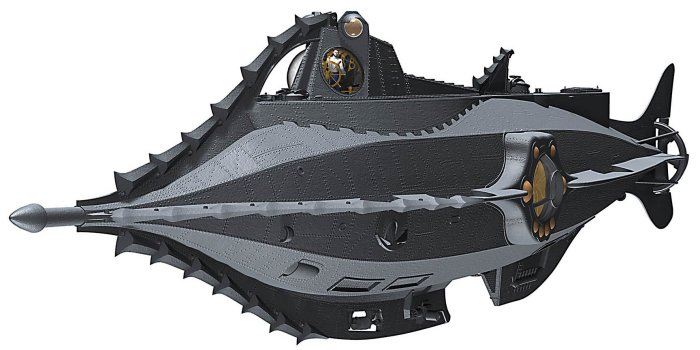
Captain Nemo’s Nautilus

Submarines would have to wait and they were still notions of fancy when Jules Verne commandeered the name of Fulton’s submarine for his own creation in 1870; Captain Nemo’s vessel in Twenty Thousand Leagues Under the Sea.

Painter of battles and fantasy myths…

Antoine_Jean_Gros_par_Gerard

Gros as a young man

On the 26th of June 1835 a body washed up on the banks of the Seine at Meudon, near Sèvres. The artist Antoine-Jean Gros’ longstanding sense of personal failure compounded by his abiding melancholic nature had finally become too much for him to bear and he had committed suicide.

But his career had always been one of emotional conflict, his naturally romantic flair often at odds with the coolly cerebral neo-classical style in favour with his closest contemporaries. In the end he could not arrive at a balance between the styles that satisfied himself and his critics and ultimately that exacerbated his own sense of failure. In hindsight though, it can be seen that Gros’ style was a major influence on the likes of Gericault and Delacroix who followed him. It is a tragedy that he could not see that for himself.

Perhaps though it is as Napoleon’s official “painter of battles” that Gros is best remembered and in a few short years after Napoleon’s coronation he became famous for his grand representations of Napoleon at his most dashing and heroic all of which were aimed at enhancing the myth of the Emperor; in the end, closer to fantasy than fact.

280px-1801_Antoine-Jean_Gros_-_Bonaparte_on_the_Bridge_at_Arcole

Napoleon on the Bridge at Arcole

It was on a visit to Genoa that Gros met Josephine de Beauharnais who, in turn, introduced him to Napoleon.  In 1796 Gros was with the French army at the Battle of Arcole and saw Napoleon famously lead the attack on the bridge. This incident he immortalized in his first major work, Napoleon on the Bridge at Arcole.

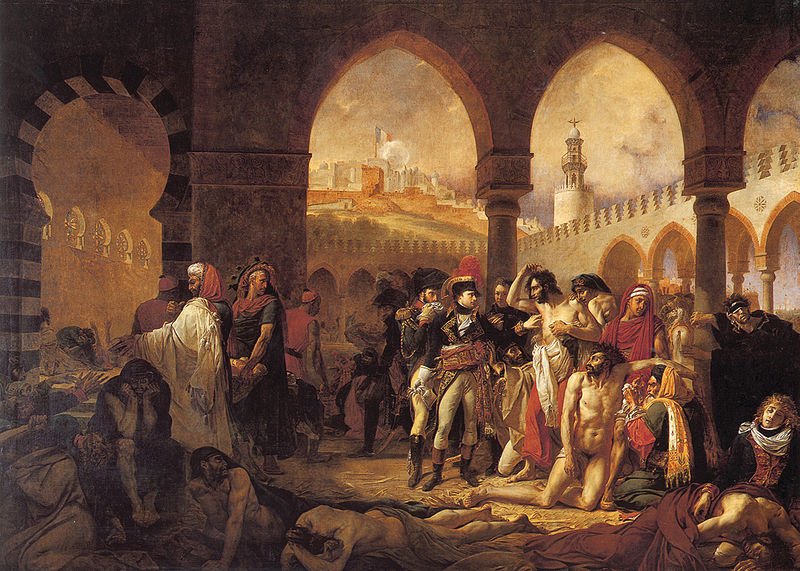
A succession of grand tableaux followed:– Napoleon Visiting the Pesthouse at Jaffa, the Battle of Aboukir, Napoleon on the Battlefield at Eylau.

napoleon-visiting-the-plague-stricken-at-jaffa-by-jean-antoine-gros

the_battle of abukir

foh8_gros_001z

But after the fall of Napoleon, the principal subject of his grand, mythologizing propaganda paintings, Gros’ star rapidly waned. None of his later works were received with the same enthusiasm as his earlier pictures and his melancholy, stoked by constant sniping from the exiled Jacques Louis David, gradually became all consuming.

A pact with the devil…?

On 12 January 2010 an earthquake devastated the Caribbean nation of Haiti resulting in the death of over a quarter of a million people. The following day, on his TV show, sitting comfortably in his armchair, the conservative US evangelist, Pat Robertson, pronounced that the tragedy could be blamed on something that “happened a long time ago in Haiti, and people might not want to talk about it.” This abject apology for a human being then went on to describe how the Haitians “were under the heel of the French. You know, Napoleon III and whatever [sic]. And they got together and swore a pact to the devil. They said, ‘We will serve you if you will get us free from the French.’ True story. And so, the devil said, ‘OK, it’s a deal.’ ”

Apart from knowing nothing about history, assuming anyone called Napoleon must be the same guy, this half-wit chose glibly to ignore the fact that the Haitian revolution led to the creation of Haiti as an independent country as a result of the only successful slave revolt in history. For the purpose of my post I will choose to ignore the Old Testament story of the Israelites being delivered from slavery in Egypt by Yahweh under the leadership of Moses – no doubt Pat Robertson wouldn’t be happy.

At the end of the 18th century Saint Domingue, as Haiti was then known, was France’s most profitable colony and half a million enslaved Africans were forced to toil on spectacularly bountiful plantations, which produced 60 per cent of all coffee and 40 per cent of all sugar consumed in Europe, more than all of Britain’s Caribbean colonies combined.

slaves

Historically, conditions for the slaves in Saint Domingue had been the harshest in the Caribbean. They were worked so hard by French plantation owners that half died within a few years; it was cheaper to import new slaves than to improve working conditions enough to increase survival and to sustain the slave workforce 30,000 slaves a year were being transported from Africa. The rate of death of slaves in Saint Domingue was higher than anywhere else in the western hemisphere. It was legal for a slaveholder to kill a slave. Torture of slaves was routine; they were whipped, mutilated and raped. The favoured form of execution was burning at the stake.

The Catholic Church condoned slavery and the practices used in the French colony, viewing the institution as a way to convert Africans to Christianity! (Pat wouldn’t be appreciative of that either.)

With the coming of the French Revolution, and the promotion of universal ideals of liberty and equality, the status quo became increasingly difficult to maintain in Saint Domingue. Plantation owners in Haiti tried to block the “dangerous” ideas coming from Paris, but the ideas spread among the slaves through smuggled pamphlets and by word of mouth.

The tinderbox ignited on the night of 21 August 1791, when the slaves of Saint Domingue rose in revolt. Within weeks, the number of slaves who joined the revolt reached some 100,000. Within the next two months, as the violence escalated, the slaves killed 4,000 whites and destroyed hundreds plantations.

By 1792, slave rebels controlled a third of the island and the following year events took a dramatic turn when the new French Republic found itself at war with Britain and Spain. Britain sent an expeditionary force to Hispaniola and, with Spain, who controlled the rest of the island, invaded Saint Domingue and were joined by the slave forces. To prevent military disaster, and secure the colony for republican France, the French political commissioners freed the slaves in Saint Domingue.

Général_Toussaint_Louverture

Toussaint L’Ouverture

The promise of emancipation persuaded the leader of the slave forces, Toussaint L’Ouverture, to switch sides and stop collaborating with the Spanish who refused to take steps to end slavery.

Toussaint L’Ouverture, a self-educated former domestic slave, was very intelligent, organized and articulate. A charismatic military leader, he essentially restored control of Saint-Domingue to France. Having made himself master of the island, however, Toussaint did not wish to surrender too much power to France. He began to rule the country as an effectively autonomous entity. Toussaint defeated a British expeditionary force in 1798. In addition, he led an invasion of neighbouring Santo Domingo (December 1800), and freed the slaves there in January, 1801.

In 1801, L’Ouverture issued a constitution for Saint Domingue which provided for autonomy and decreed that he would be governor-for-life, calling for black autonomy and a sovereign black state.

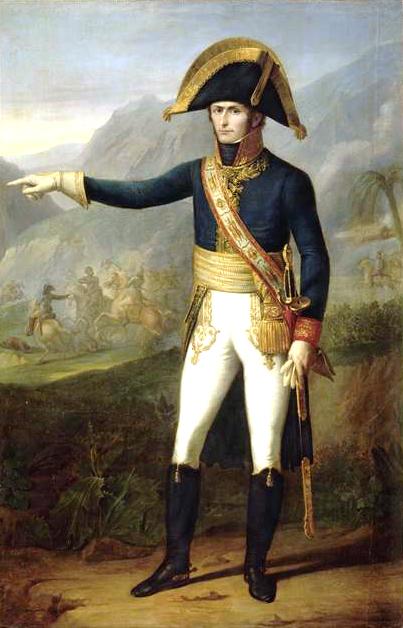
Général_CHARLES-EMMANUEL_LECLERC_(1772-1802)

Charles LeClerc

This was a step too far for Napoleon Bonaparte. Lobbied by plantation owning interests and craving the tax wealth brought in from the colony Napoleon dispatched a force of 80,000 French troops to the island, led by his brother-in-law Charles Leclerc, to restore French rule. They were under secret instructions to restore slavery, at least in the formerly Spanish-held part of the island. L’Ouverture, deceived, was seized by the French and shipped to France. He died months later in prison at Fort-de-Joux.

For a few months, the island was quiet under Napoleonic rule. But when it became apparent that the French intended to re-establish slavery, black forces revolted in the summer of 1802.

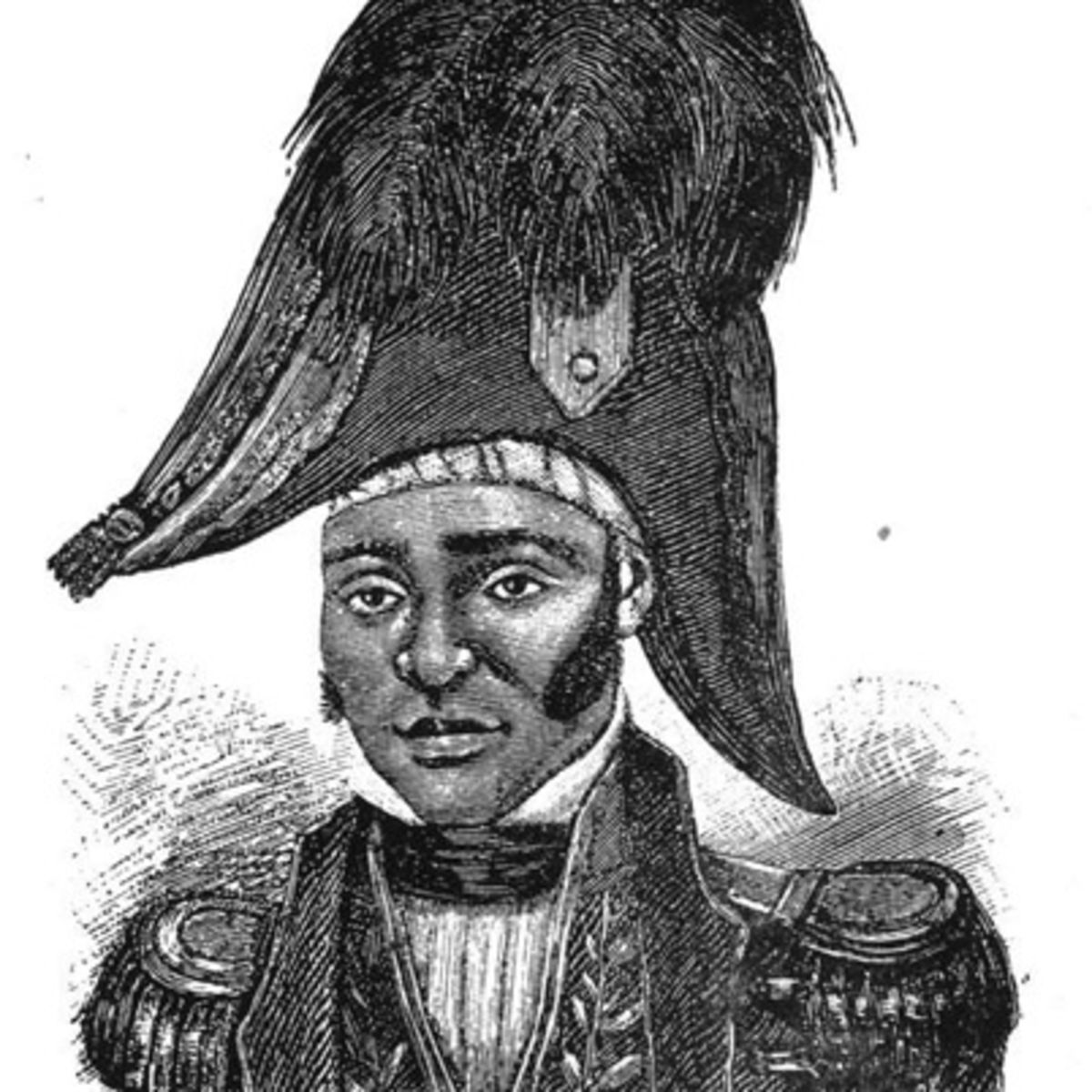
dessalines

Jean Jacques Dessalines

Jean Jacques Dessalines, a former lieutenant of  L’Ouverture,  led the fresh rebellion. In November, Leclerc died of yellow fever, like much of his army. His successor, the Vicomte de Rochambeau, fought an even more brutal campaign. His atrocities helped rally many former French loyalists to the rebel cause. The French were further weakened by a British naval blockade, and by Napoleon’s inability to send the requested massive reinforcements after war with England resumed in the spring of 1803. Having sold the Louisiana Territory to the United States in April 1803, Napoleon began to lose interest in his failing ventures in the Western Hemisphere. He was more concerned about France’s European mainland enemies. Consequently, he withdrew a majority of the French forces in Haiti to counter the possibility of an attack from Prussia, Britain, and Spain. Dessalines led the rebellion until its completion, when the French forces were finally defeated in November 1803.

On 1 January 1804, Dessalines officially declared the former colony’s independence, renaming it “Haiti” after the indigenous Arawak name. Haiti was the first independent nation in Latin America, the first post-colonial independent black-led nation in the world, and the only nation whose independence was gained as part of a successful slave rebellion.

It has been estimated that the brutal Haitian Revolution from 1791 to 1804 resulted in the deaths of 350,000 black and mulatto Haitians and over 50,000 European troops. To cement his control Dessalines ordered one final massacre; the virtual eradication of the remaining white population of Haiti. Between February and April of 1804 almost 5000 remaining white French Creole inhabitants were murdered. The 1804 massacre had a long-lasting effect on the view of the Haitian Revolution and helped to create a legacy of racial hostility in Haitian society.

Swashbuckling stories from the descendant of a slave…

Not much is known of Marie-Cessette Dumas; even her name is the subject of contention. One of only two primary sources mentioning her has her first names spelled two different ways in the same document and her surname has variously been claimed to be derived from the fang (west African language) word “dûma”, meaning “dignity” or merely from the French “du mas” meaning “of the farm”, a descriptive addition to her first names meant to signify that she belonged to the property.

Either way, she was a black slave, likely captured in West Africa and shipped to the French colony of Saint-Domingue, now Haiti, where she was bought by Marquis Alexandre Antoine Davy de la Pailleterie some time before 1762. They resided on the plantation of La Guinaudée where Marie-Cessette became his concubine and together they had three children.

It is unclear what fate befell Marie-Cessete. One source suggests she died in 1772 of dysentery. However, a more compelling theory, backed up by a 1776 letter from a retired official on the island, is that the Marquis sold her together with their two youngest children, and the daughter she had with another man prior to their relationship, to a nobleman from Nantes.

This occurred just prior to the Marquis arranging for the other child, the then 14-year old Thomas-Alexandre, to accompany him on his return to France whereupon he was freed. Thereafter, the Marquis spent lavishly on his son, ensuring his education and providing him, in 1784, with a swanky apartment near the Louvre Palace.

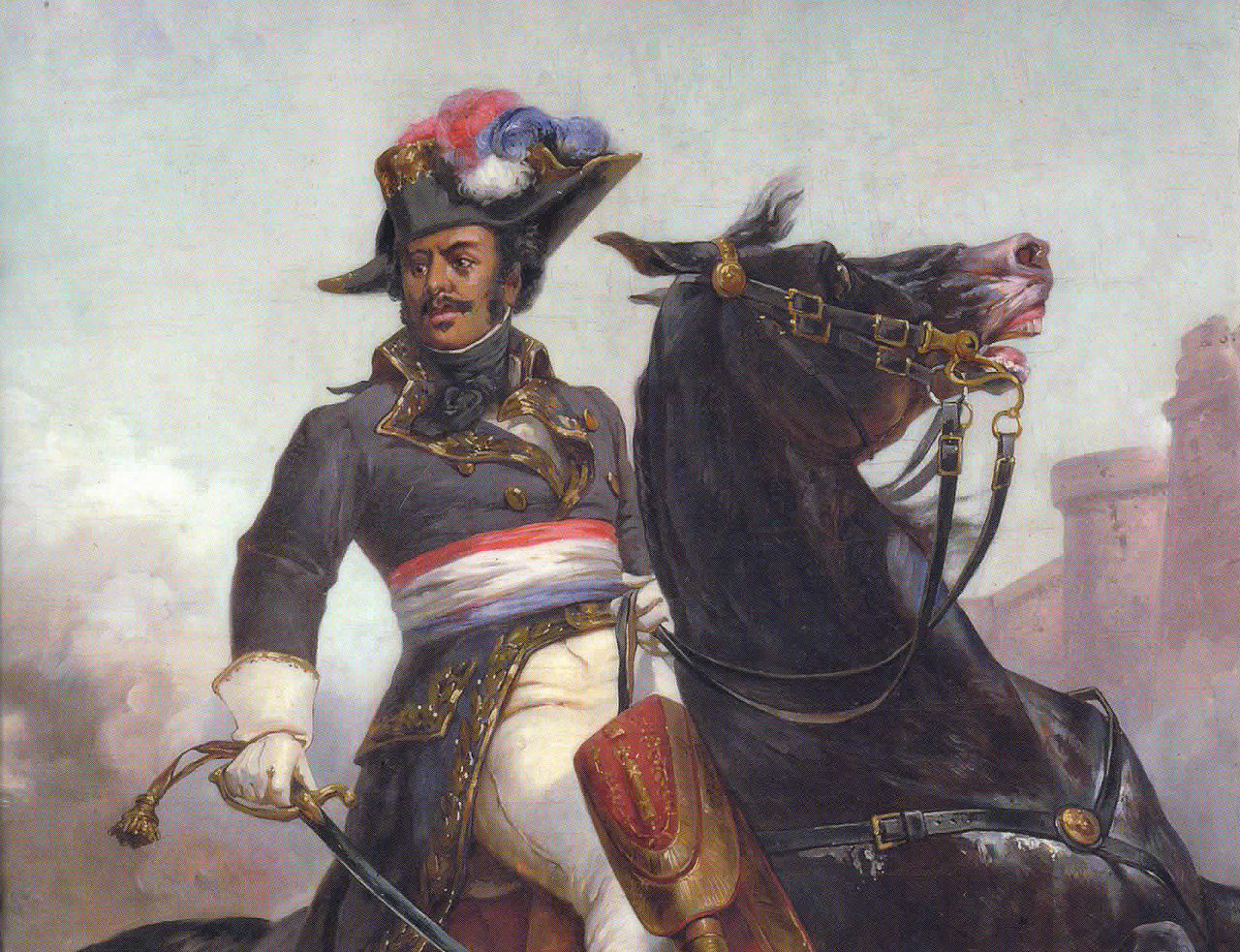
general Alexandre_Dumas_(1762-1806)

Alexandre Dumas – soldier

Two years later though relations between Thomas-Alexandre and his father broke down following the Marquis’ marriage to a domestic servant on his estate. Thomas-Alexandre joined the army as a private, his mixed race making it difficult for him to claim noble privilege and join as a commissioned officer, and from this time on he began calling himself Alexandre Dumas.

With the outbreak of Revolution, promotion came fast; lieutenant colonel in 1792, brigadier general by July 1793 and general of division just a month later. By the end of that year he was commander of the Army of the Alps and captured the strategic stronghold of Mount Cenis from the Piedmontese.

Somehow though he fell victim to the mad world of the politics of the day, was denounced and called to appear before the Committee of Public Safety during the Terror. However, he managed to delay his journey to Paris long enough so that Robespierre fell before he was seen.

Service with the Army of the Rhine and the Army of Italy under Bonaparte then followed but relations between Dumas and Bonaparte were strained as Dumas resisted the policy to expropriate local property indiscriminately. However, following Dumas’ heroic effort to single-handedly drive back an entire squadron of Austrian troops at a bridge over the Eisack River, Napoleon rewarded him by making him commander of all cavalry in the Tyrol and the following year giving him command of the cavalry he took to Egypt.

Within a few months the relationship between Napoleon and Dumas had collapsed with Dumas being accused of sedition and being removed from command. Things went from bad to worse for Dumas as his ship sank on the return journey to France and he was imprisoned in Taranto by the forces allied to the Kingdom of Naples.

During two years of captivity his health was broken and he never saw active service again.

In 1802, he and his wife Marie-Louise had their third child, a son, who they inevitably name Alexandre but they were struggling to make ends meet and when Thomas-Alexandre died of cancer in 1806 his widow and her children were plunged into poverty.

Alexander_Dumas_père_(1802-1870)

Alexandre Dumas – author

The next few years were hard but the family still had their father’s distinguished reputation and finally, after the restoration of the monarchy one of Marie-Louise’s letters to her late husband’s comrades finally paid off. General Maximilien Foy, impressed with Alexandre’s elegant handwriting, secured him a position as a clerk to the Duc d’Orleans, later King Louis Phillippe.

With the security of a steady income behind him he began to devote more energy to his own writing and by 1829 he was beginning to see success. That success would grow and grow. And alongside his publishing success he was to lead a life that was almost as exciting as the characters he wrote about.

He took part in the Revolution of 1830. He built a fantastic chateau on the outskirts of Paris and had to sell up two years later because acquaintances had taken such advantage of his generosity. He travelled widely to Belgium, to Russia and to Italy where he participated in the movement for the unification of Italy.

He wrote in a wide variety of genres and published a total of 100,000 pages in his lifetime. His works, including some all-time classics like The Three Musketeers and The Count of Monte Cristo have since been translated into a hundred languages and have sold more than any other French author.

alexandre dumas metroAnd he also has a Paris Metro station named after him!

EA 24; the code of the code-breaker…

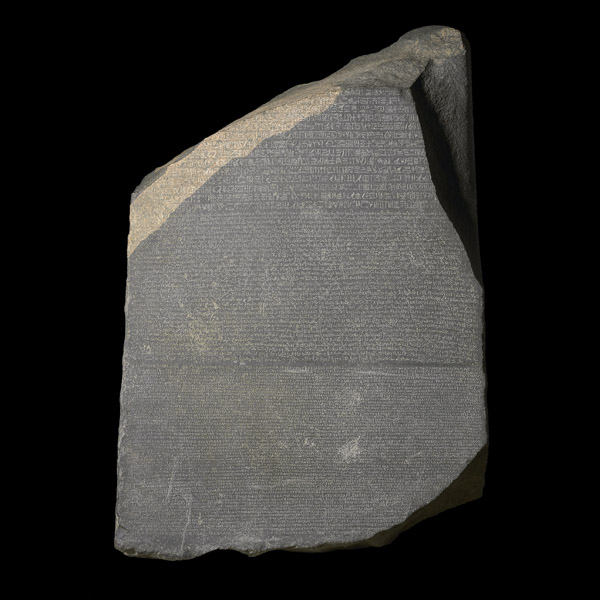
rosetta stoneOn the 15th July 1799 soldiers under the command of a lieutenant of engineers, Pierre-François Bouchard, were digging foundations for an extension to Fort St. Julien at El Rashid in Egypt when their pick axes and shovels uncovered a slab of black rock with one side covered in masses of engraved text.

Luckily for history, Napoleon’s campaign in Egypt was accompanied by a large body of experts from a variety of disciplines from the Commission des Sciences et des Arts and Bouchard immediately recognised that the stone he had found at El Rashid, then known as Rosetta, would be of interest to the scholars.

bonaparte in front of the sphinx

Bonaparte in Egypt

The first report of the find, just a few days later, by Michel Ange Lancret noted that it contained three inscriptions, the first in hieroglyphs, the second being a language as then unknown and the third in Greek. Lancret rightly surmised that the three inscriptions would be versions of the same text so hopes were raised of it perhaps being able to unlock the secrets of Egyptian hieroglyphs that had completely defeated scholars.

By the time Napoleon himself inspected the find on its arrival in Cairo shortly before his return to France in August 1799, it had already begun to be called la Pierre de Rosette, the Rosetta Stone.

A few months later, in 1800, a gifted linguist attached to the French army in Egypt recognised that the middle text was written in the Egyptian demotic script, rarely used for stone inscriptions and, therefore, seldom seen by scholars at that time.

For the next 18 months, following the departure of Napoleon back to France, the remaining French forces were gradually worn down and ultimately surrendered to the British at the end of August 1801 whereupon the Rosetta Stone passed into the possession of the British Army. The grandly named, Colonel Tomkyns Hilgrove Turner escorted the stone back to England where it was presented to King George III in February 1802.

Rosetta_news

Report of the arrival of the Rosetta Stone in the English press

The King decreed that it should be placed in the British Museum where it was assigned the inventory code EA 24, EA standing for Egyptian Antiquities. It has been on display there ever since except for two years during World War 1 when it was removed due to fears of German bombing and housed in a station of the Postal Tube Railway 50 feet below Holborn.

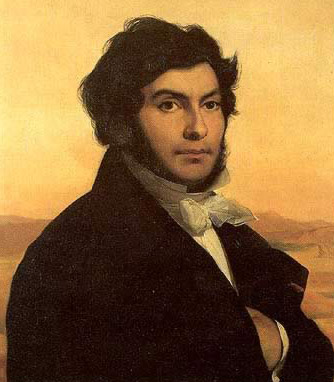
Over the next twenty years scholars worked on the tablet and after initial breakthroughs by Silvestre de Sacy and the key discovery by Thomas Young that the cartouches contained phonetic characters. This led to Jean-François Champollion being able to construct an alphabet of phonetic hieroglyphic characters which was published in 1822.

champillion5

Champollion

It is perhaps fitting that the crucial break in deciphering the hieroglyphs should have been made by a French scholar.