Satirist with a secret…

“The Plumb-pudding in danger” by James Gillray is probably the most well-known political cartoon of the Napoleonic period, with British Prime Minister William Pitt sitting  opposite Napoleon Bonaparte, both of them slicing up the globe in a bid to gain a larger portion.

800px-Caricature_gillray_plumpudding

But Gillray was not the only satirical cartoonist plying his trade during the period and I recently came across George Cruikshank. Though probably not as well known as Gillray, he had a most remarkable life, living to an age  when photography had been invented and, in later years, leading a double life!

cruikshank

George Cruikshank

George was born into a family of political caricaturists. His father Isaac, and his elder brother Robert were cartoonists and the younger sister Eliza was also a dab hand with a pen or brush.

By the age of about seven George was sketching competently. At ten he was supplying simple designs to wood engravers for children’s games and books. His father taught him the fundamentals of etching into copperplates and by thirteen George was executing the titles of his father’s caricatures, and also putting in backgrounds, furnishings and dialogue.

By the age of twenty he was a a famous cartoonist in his own right providing material for rival radical publications The Scourge and The Meteor. This cartoon is typical of Cruikshank towards the end of the Napoleonic wars.

Cruikshank_-_Little_Boney_gone_to_Pot

Little Boney Gone to Pot

Here Napoleon is sitting on a chamber pot ( “Imperial Throne ” ) on the island of Elba. He is in a forlorn condition, suffering from the itch, with large excrescences growing on his toes. He is all alone in his island prison, and tempted by a fiend, who offers him a pistol—“If you have one spark of courage left,” it says, “take this.” “Perhaps I may,” replies Napoleon, “if you’ll take the flint out.”

By his side is a pot of brimstone, numerous medicine bottles, and “a treatise on the itch, by Dr. Scratch.” One of the imperial boots, mounted on a carriage, forms a dummy cannon. His back leans against a tree, to which is nailed the “Imperial Crow,” while from the branches hang a ragged pair of breeches and stockings. The whole effect is to symbolize the Emperor’s decline of power.

After the war George created his best-remembered work as an illustrator for Sketches by Boz and Oliver Twist by his ‘on-off’ friend, Charles Dickens. Sketches by Boz was published in February 1836 with Cruikshank’s 16 etchings, which were praised by Dickens in the introduction.

In 1827, George  married Mary Ann Walker. They were childless, with Mary Ann suffering from ill health, possibly tuberculosis, until her death in 1849. Two years after her death, in March 1851, he married Eliza Widdison. Throughout this period he supported his younger sister and his mother, his father having died of alcohol poisoning in 1811.

On the surface, the bohemian lifestyle of Cruikshank’s youth gave way to sobriety, and the friendship between Cruikshank and Dickens soured when Cruikshank became a fanatical teetotaler in opposition to Dickens’s views of moderation. Though all was not what it seemed in Cruikshank’s private life. He seduced one of the young housemaids, Adelaide Attree, and set her up in her own house virtually round the corner from the house he shared with his wife. He fathered 11 children with his mistress and his maintenance of two households was not fully revealed until after his death in 1878 at the ripe old age of 85.

Punch magazine, which I assume did not know of George’s double life, said in its obituary: “There never was a purer, simpler, more straightforward or altogether more blameless man. His nature had something childlike in its transparency.”

Really?
Remembrance of times past…

Those of us lucky enough to have grown up in “peace time” since the Second World War are very familiar with the sight of hundreds, even thousands, of veterans of the armed forces parading on Remembrance Sunday past the cenotaph in Whitehall. They wear their medals with pride and they march past with fixed expressions that mask myriads of memories, good and bad.

But this is nothing new.

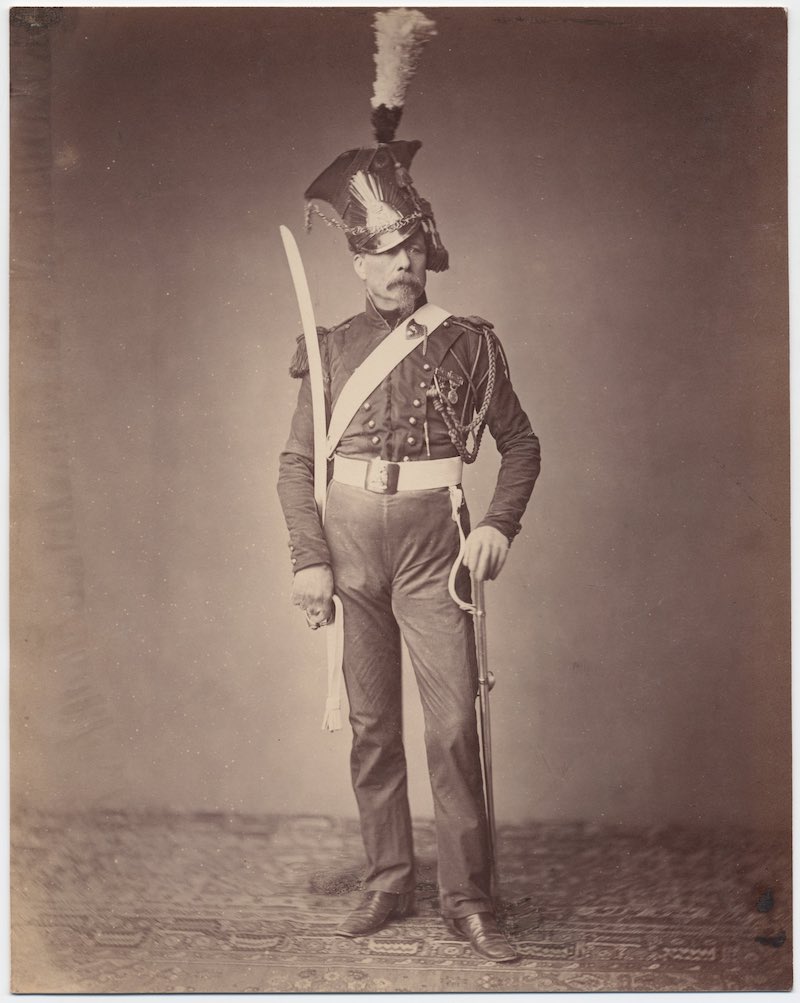
Monsieur Verlinde of the 2nd Lancers 1815

Monsieur Verlinde of the 2nd Lancers, 1815

Grenadier Burg 24th Regiment of the Guard 1815

Grenadier Burg, 24th Regiment of the Guard, 1815

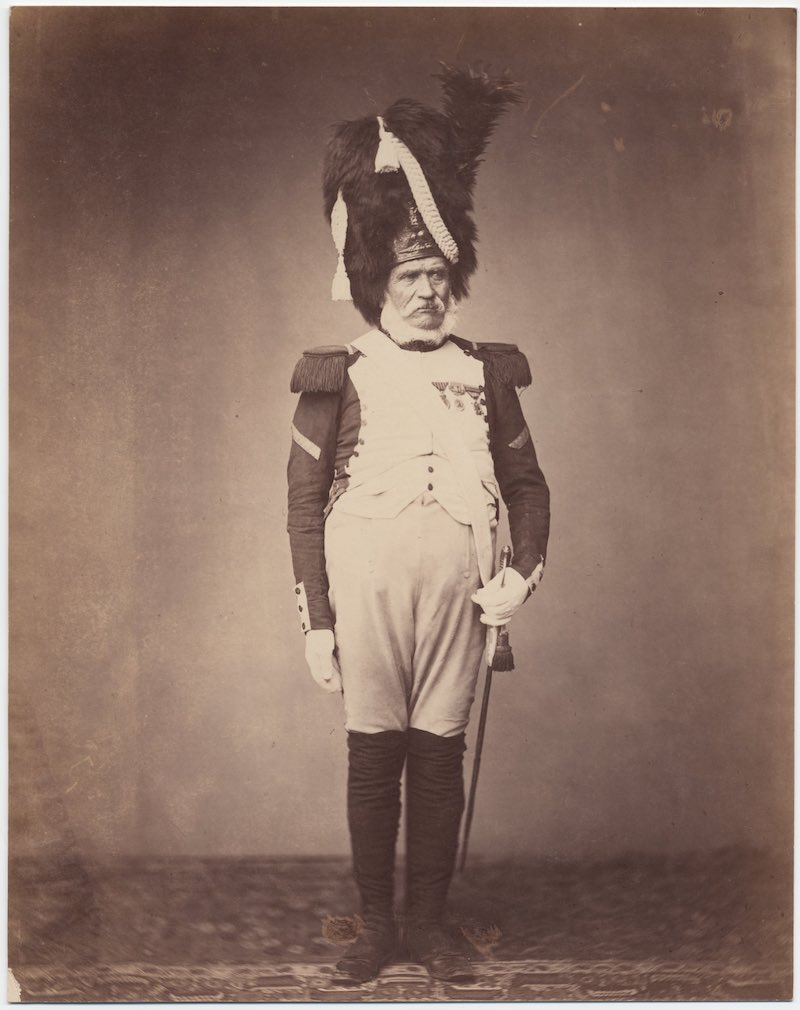
Back in May 1858, less than twenty years after the first complete practical photographic process was announced at a meeting of the French Academy of Sciences, French veterans of the Napoleonic wars were photographed after their annual reunion in the Place Vendome on the anniversary of the death of Napoleon.

It was customary for the old soldiers to turn out in the uniforms they had worn with pride and distinction all those years before.

Monsieur Mauban 8th Dragoon Regiment 1815

Monsieur Mauban, 8th Dragoon Regiment, 1815

They were in their sixties, seventies or even eighties, their waistlines had expanded in some cases and perhaps some clever tailoring had been required to enable them to dress still as they had as young men. But there was no alteration required to dress how they held themselves.

Though a little frail, blurring here and there telling its own story of how some found it a bit difficult to stand stock still for the lengthy exposures, nevertheless the pride of these men shines through.

moret and delignon

I am particularly taken with the image of Sergeant Taria of the Emperor’s Guard; as an old man he looked formidable. How much more so would he have been in his prime.

Sergeant Taria Grenadiere de la Garde 1809-1815

Sergeant Taria, Grenadiere de la Garde, 1809-1815

Serving from 1809-15 his experiences would have encompassed Aspern-Assling and Wagram, the horrors of the Russian campaign, the defensive campaigns of 1813-14 with France’s enemies pressing in from all sides, and finally the Hundred Days and that fateful, awful day of Waterloo when allied and French casualties were close on 50,000. I can’t imagine what his eyes must have seen.

All photographs are copyright of the Anne S. K. Brown Military Collection.

Elisabeth Louise Vigée Le Brun… an independent woman in a man’s world

When I was doing some research on the life of Catherine Talleyrand I inevitably came across the portrait of her during the time when she was perhaps the most famous courtesan in Paris; her 1783 portrait by Élisabeth Louise Vigée Le Brun.

I was surprised that the painter was a woman and I couldn’t think of any other women artists of the period. But it turns out that was hardly a surprise. In many European countries the national “academies” were all powerful in the artistic sphere. They were responsible for artistic training, exhibitions, and inevitably artistic promotion through being the arbiters of style. Membership of the academies was closely controlled and most were not open to women. For example, in France, the Academy in Paris had 450 members between the end of the 17th century and the French Revolution; only fifteen were women and, of those, most were daughters or wives of existing members.

vigee-le-brun-self-portrait-straw-hat-ng1653-c-face-half

Elisabeth Louise Vigée Le Brun self-portrait

Elisabeth Louise Vigée Le Brun was born in Paris on April 16, 1755. Her father was a successful artist who encouraged her interest in art. She had a natural talent and, when still a teenager, began to attract wealthy clients to have their portraits painted. When, still only 19 years of age, she was accepted into the painters’ guild of the Académie de Saint-Luc, this increased her professional exposure significantly. In 1776 she married Jean-Baptiste Le Brun, an artist and art dealer, with whom she had one daughter, Jeanne-Julie-Louise.

Vigée Le Brun soon became a popular portraitist among the French aristocracy and, in 1779, went to Versailles to paint her first portrait of Marie Antoinette. She became the queen’s favorite portraitist and painted her a total of 30 times over the next decade. It was through the queen’s influence that, in 1783, Vigée Le Brun was accepted into the Académie Royale de Peinture et de Sculpture, France’s most prestigious professional association for artists, which admitted very few female artists.

In 1789, with Revolution breaking out, Vigée Le Brun fled France with her daughter though her husband remained behind. For the next sixteen years she travelled widely, firstly in central Europe, then spent six years in Russia and finally two years in London before ultimately returning to France in 1805.

She had continued to work throughout this time, it being her only means of independent support, and her paintings were prolific; in her time in Russia alone she produced 44 portraits, her subjects including Tzar Alexander and his wife.

Back in France she suffered no apparent effects from being an emigre in exile and, within months, Napoleon had commissioned a portrait from her of his sister, Caroline, the wife of Marshal Murat. Though Vigée Le Brun describes the sittings as being nothing but a trial due to her sitter’s capricious temperament. In her memoirs she makes no bones about her annoyance. One day when she had been made to wait interminably for the lady to appear she commented to one of her attendants:

…loudly enough for her [Caroline] to hear, “I have painted real princesses who never worried me, and never made me wait.” The fact is, Mme. Murat was unaware that punctuality is the politeness of kings, as Louis XIV so well said.

Vigée Le Brun continued to paint until the late 1820s. She died at her Paris residence on March 30, 1842.

Carry On Napoleon…

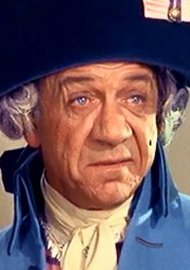
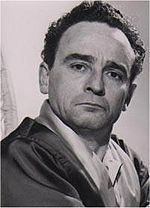
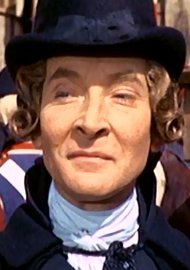
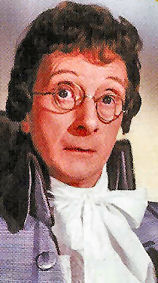
The more I read about the household of Napoleon, it seems to me more like the cast of a “Carry On” film rather than the inner circle of one of the most important figures in history. Drunken coachman, melancholic tailor, antagonistic chef, exotic bodyguard, gossiping valet. I can’t help but think of their parts being played by Messrs. James, Connor, Williams, Bresslaw and Hawtrey.

But they say fact is often stranger than fiction and the retinue of Napoleon seems to bear this out.

sid james

Drunk driver

Let’s start with Cesar, the coachman. He was a notorious drunk and it is something of a mystery why Napoleon put up with him. Perhaps because the great man always seemed to be in such a hurry Cesar’s manic driving somehow fitted the bill.

Yet it was just such driving, Cesar’s recklessness, that saved the life of Napoleon on Christmas Eve 1800. Josephine had persuaded him to attend a concert that evening and he set off in his carriage, driven as usual by Cesar, who was most decidedly full of the Christmas spirit. Josephine, her two daughters Caroline and Hortense, with Napoleon’s ADC Jean Rapp, followed in a second carriage a couple of minutes behind.

On the Rue St. Nicaise, plotters had set a bomb in a cart by the side of the road, held there at their behest by an unwitting girl. As the Consul’s escort trotted past the bomb’s fuse was ignited. Any other coachman, seeing the road partially blocked by the cart would have slowed to edge past the obstacle but not Cesar. Without a care in the world he raced the carriage past the cart that held the bomb. When it detonated Napoleon was safely round the corner in the Rue de la Loi. The bomb took out most of the block, bringing down the frontages of buildings on both sides of the street and killing nine innocent civilians. Nearly thirty more were injured. In the second carriage Hortense received a gash to her arm from flying glass and Caroline, who was eight months pregnant was badly shocked. It was the closest any assassination attempt came to succeeding.

kenneth connor

Down-trodden tailor

Moving on, I would guess that Napoleon, for his evening at the concert, would not have dressed up. His simple taste in clothes was the bane of his tailor’s life. Bastide, the tailor, was the make-do-and-mend flunky. Napoleon was frugal and spent as little as possible on his wardrobe, preferring simple uniforms and clothes that were comfortable and practical… and would last for an eternity. It was Bastide’s job to keep them serviceable. Even when Napoleon did splash out on something elaborate, such as his coronation robes, poor Bastide never got a look in. Those jobs were always farmed out to someone famous. So the lot of the great man’s tailor was not a happy one.

kenneth williams

Supercilious chef

Also often unhappy, but more prepared to make a fight of it, was Napoleon’s chef, Dinan. Formerly the chef of the one of the Bourbon dukes, he considered his culinary inventions to be works of art. But Napoleon’s view of food was purely functional. He considered food as fuel and little more. His tastes were simple and he wolfed down his food. Meals were sprints, over and done with in twenty minutes. But Dinan was stubborn too and persisted in producing his multiple courses, rich sauces and lavish desserts. He also took it upon himself to make executive decisions about the Emperor’s menu… big mistake. When he substituted a strong garlic sausage that was a particular favourite of Napoleon’s because he thought it was too vulgar that was a decision too far and Napoleon let rip at his chef. In the ensuing argument Dinan threatened to resign but compromise was finally reached. The maestro agreed to give the Emperor more of the food he preferred while Napoleon agreed to the multiple courses though he tended to leave more than he ate.

charles hawtrey

Self-important valet

Witness and chronicler of all of his was Constant, Napoleon’s valet. His memoirs read like a gossip’s charter but he was faithful to Napoleon for many years. Though I can’t help but think he must have been the sort who imagined their own status was somehow a reflection of their master’s import.

bernard bresslaw

Intimidating bodyguard

And finally their was Roustam Raza, the massive bodyguard. Armenian by birth, he was a slave in the service of the Sheik of Cairo when he was presented to Napoleon as a gift. From that time the giant bodyguard was never more than a few feet from his master. Always attired in traditional Mamluk dress – plumed turban, baggy trousers, embroidered jacket and massive curved scimitar. When they travelled by coach Roustam sat beside Cesar driving the carriage (worse luck for him). At night he slept outside Napoleon’s bedroom, lying across the door like some devoted guard dog.

He accompanied his master on all his great campaigns, including Russia where he found the cold intolerable. In the final months of the empire with Napoleon falling back on Paris he fought bravely in numerous engagements.

Although he finally broke with Napoleon when the Emperor was exiled to Elba, a decision which Napoleon found more hurtful than many of the betrayals he experienced at that time, he was on hand when in 1840 his old master’s body was returned from St. Helena for re-interment in Paris.

Napoleon was rubbish…

…at billiards!

He had no liking for the game and even less aptitude. He preferred to use the green baize table for laying out his maps; much better than spreading them around him on the floor. Yet even the Emperor who had no liking for the game, in exile on St Helena, had a billiards room in his house, Longwood (below).

Billiard-Room-Longwood-021

Not necessarily ironically but perhaps comically, his two wives, Josephine de Beauharnais and then Marie Louise of Austria, were much more enthusiastic players and I can only imagine the Emperor’s fits of temper as he was beaten for the umpteenth time by one wife or another.

By the time of Napoleon, the game had already had a long history. It is thought its original form was played in France since the 1340s and Louis XI certainly owned a billiard table in the 1470s. It is thought the name derives from the term “billart”, one of the sticks originally used to shove the balls across the table.

Josephine had a billiards room in her chateau of Malmaison and often had a game before breakfast but, more often, played late at night, as recounted in the memoirs of Louis Constant, Napoleon’s valet:

“She loved to sit up late, when almost everybody else had retired, to play a game of billiards… It happened on one occasion that, having dismissed everyone else, and not yet being sleepy, she asked if I knew how to play billiards, and upon my replying in the affirmative, requested me with charming grace to play with her; and I had often afterwards the honour of doing so.”

Apparently Josephine’s daughter, Hortense, was a whizz around the table. It seems poor Napoleon was surrounded by women who could thrash him at the popular salon game.

But there was another element to the game which made it a rather appealing spectator sport, for some. Ladies’ fashion of the time was for flattering dresses in gauzy material and low, scooped necklines.

Louis-Léopold_Boilly_-_Game_of_Billiards_-_WGA02350

Boilly’s painting, here, has a distinctly erotic element to it. And it’s not just my lurid imagination running away with me. In the always-frank memoirs of Captain Coignet, serving in the Imperial Guard, he comments on a similarly pleasurable pastime regarding the billiards prowess and style of the Empress Marie Louise:

“Marie Louise was a first-rate billiard-player. She beat all the men; but she was not afraid to stretch herself out across the billiard-table, as the men did, when she wanted to make a stroke, with me always on the watch to see what I could.”

When he adds, “She was frequently applauded” I find I’m not at all surprised.

Near bald, near blind, near brilliant…

davoutLouis Davout (or Davoust as it was commonly written during his lifetime) was the son of minor nobility from Auxerre. Following an education at the military academy in Auxerre and then the École Militaire in Paris he was appointed to a junior officer post in the Royal-Champagne Cavalry Regiment, but on the outbreak of Revolution he eagerly embraced its principles.

Transferring to a volunteer infantry regiment he distinguished himself at the battle of Neerwinden in 1793 and, by the age of 23, was promoted to General of Brigade. Following further service on the Rhine front between 1794-97, he accompanied Bonaparte on his Egyptian expedition where he fought at The Pyramids and Aboukir.

On his return he missed the 1800 northern Italian campaign in which his friend Desaix was killed saving Bonaparte’s bacon at Marengo. But Bonaparte showed his confidence in him by promoting him General of Division and giving him command of the Consular Guard. Now Davout would become Napoleon’s staunchest supporter.

In 1804, when Napoleon became emperor, Davout was the youngest of the generals promoted to Marshal. His youth raised eyebrows and sparked not a little jealousy in some quarters but Napoleon would be proved to be a great judge of character. At this point Davout had had command of III Corps for a little over a year and was in the process of transforming it through discipline and training into the finest unit in the French army and setting the seed for his sobriquet, “The Iron Marshal”. He was harsh, difficult to get on with and had no patience with those who tried to take the easy way out. But he was honest and always mindful of the well-being of his men. These attitudes would mean he would get on well with few of his fellow marshals.

At the Battle of Austerlitz in December 1805, after a forced march of forty-eight hours, III Corps was the anvil upon which Bonaparte pulverised the Russians and Austrians, but it was the following year at Auerstadt that he showed his true brilliance when his single corps defeated a Prussian force double the size of his own. In a hard fought day he battled the bulk of the main Prussian field army to a standstill and then swept them from the field in one of the greatest military displays in history.

Unfortunately for him, Davout’s victory at Auerstadt was on the same day as Napoleon’s victory at Jena a few miles away and of course the subordinate’s victory was played down compared with the Emperor’s. Though Napoleon recognised the scale of his Iron Marshal’s victory, and when it came time to bestow on Davout a ducal title, it was as the Duke of Auerstadt.

Further service followed for Davout; commanding well at the battles of Eylau, Eckmuhl, Ratisbon, and Wagram, being made Prince of Eckmuhl in 1809. And all of this battle leadership despite barely being able to see his hand in front of his face.

On he went, performing well during the ultimately disastrous Russian campaign of 1812. He beat Bagration at Mohilev and commanded well at Smolensk and Borodino. However, the wheels came off during the infamous retreat from Moscow. Never popular with some of his senior colleagues, he had made particular enemies of Berthier, Jerome Bonaparte, and Murat who was Jerome’s brother-in-law. Together they conspired to turn Bonaparte’s opinion against Davout and he was replaced by Ney in command of the rearguard.

The following year he was given the task of holding Hamburg and put up a sterling defence, defying the siege for more than a year, only relinquishing the city when Napoleon was toppled in 1814.

During the Hundred Days when Napoleon returned from Elba, Davout rejoined him but was inexplicably given a ministerial post in Paris rather than a field command.

If Napoleon had had Davout with him then maybe the results of the campaign could have been very different. I doubt Davout would have wandered aimlessly through the Belgian countryside with 30,000 troops as Grouchy did on the day of Waterloo. He would have marched to the sound of the guns and who knows what difference that force would have made under the command of the Iron Marshal.

Beautiful, dimwit, survivor, princess… Catherine Talleyrand

In researching the background to a follow up to my novel Bitter Glory, I have become interested in some of the female characters who populated Napoleonic high society. I think several will end up as the subjects of posts here but I have chosen Catherine, the wife of Napoleon’s Foreign Minister, the arch schemer Charles Maurice de Talleyrand-Périgord.

Catherine Noele Worlée was born in India in 1762, in the hot and sultry southern region of Tamil Nadu, the daughter of a French colonial administrator. It is undoubtedly fanciful but I can’t help but think of that region of crazy heat, sultry humidity, exotic spices and full of contrasts as some kind of metaphor for the lady’s character.

For Catherine was just 15 when she became mistress of George Francis Grand, an English civil servant, shortly after her family relocated to Chandannagar. They were married the following year, 1778. Yet within a year of their marriage an outraged George Grand had caught his wife in flagrante with Sir Philip Francis, a member of the supreme council of Bengal.

For the next three and a half years Catherine lived with Philip Francis… and his wife in an apparently amicable arrangement. But in 1782, for reasons that are unclear Catherine left India and set sail for France. In Paris over the next ten years she moved through a series of lovers each either wealthier or better connected than the last; bankers, politicians, aristocrats. When Vigee Le Brun painted her portrait here she was one of the most famous courtesans in Paris.

catherine_princesse_talleyrand_001

But in 1792, with the horrors of the Terror just around the corner, she fled Paris for London and the patronage of more influential lovers.

She remained in London for three years, returning to Paris in 1795 after the fall of Robespierre and his Committee of Public Safety and the establishment of the more moderate Directory. A year later she had been introduced to Talleyrand and by 1797 they were lovers, Talleyrand having set her up in her own house at Montmorency.

They were certainly an odd couple. Perhaps it was the attraction of opposites. Talleyrand was urbane, aristocratic, fiercely intelligent, ruthlessly calculating and Catherine was, frankly, none of these things. She was of relatively low birth and had little formal education and she is mocked in various memoirs as being a dimwit; her social faux pas became the stuff of legend in polite society. The story of her mistaking the French traveller, writer, and artist Vivant Denon for Robinson Crusoe and insisting over dinner on talking about how he met Friday may be apocryphal but it gives an idea of the stories about her that were doing the rounds. But, perhaps Talleyrand had had his fill of the imperious Germaine de Stael and her ilk.

And let’s face it, Catherine had other attributes; her beauty was incontestable. With blue eyes, luxurious masses of blonde hair, perfect skin and incomparable grace, she was acknowledged as one of the reigning beauties of the time.

Through Talleyrand’s influence Catherine finally secured a divorce and in 1798 she had moved into his Paris residence where the celebrity couple of the age embarked upon a glittering round of social engagements. Invitation to the Hotel Gallifet became the most sought after ticket in Paris.

In 1802 the couple married at the urging of Napoleon Bonaparte who did not appreciate his chief minister living openly with his mistress, but after their marriage the couple began to drift apart, her husband ultimately giving her enough money to live luxuriously in London.

The Princesse de Benevente, for she kept her husband’s title, moved back to Paris to live out the last few years of her life and she died there in 1834.

Standard opinion of Catherine is that she was stupid but I’m not so sure. In an age where women were most distinctly second class citizens she rose from obscurity to fame and fortune using whatever talents and attributes she had. She ended up a princess, fabulously wealthy and had married the man who, after Napoleon, was the most powerful in France. Not bad for a provincial nobody.