
William Burgess Cunningham was born on 23 Nov 1889 into a poor working class family living at Old Brown Yard in Leeds. After leaving school he became a carter but aged 17 on 21 Jan 1907 he enlisted in the Royal Navy, signing on for 12 years. At his enlistment he was described as being 5’4” tall with brown hair, brown eyes and a fresh complexion. He joined the Navy as a Boy 2nd Class.
His first posting was to the training establishment, HMS Ganges, in Suffolk. In the same year William arrived at HMS Ganges, the now iconic 143-foot mast was installed and every boy who arrived was required to climb it.
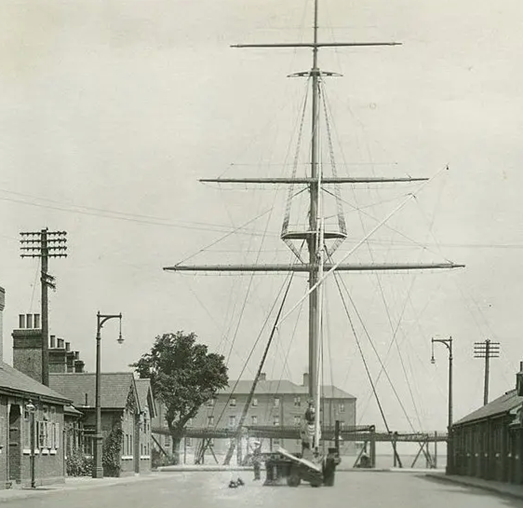
William remain at Ganges until July 1907 by which time he had become Boy 1st Class whereupon he was posted to his first ship, HMS Bulwark but he would spent just three months there before being transferred to HMS Terrible for just one month and then on to HMS Crescent on his 18th birthday now ranked Ordinary Seaman.
HMS Crescent was a cruiser attached to the Portsmouth Division of Home Fleet 4th Cruiser Squadron but William’s posting there would also be short because by January 1908 he was aboard HMS King Alfred, an armoured cruiser and flagship of the China Station since 1906.

This was William’s first lengthy posting and he would remain with the King Alfred for two and a half years being promoted to Able Seaman in May 1909. When the King Alfred returned to home waters William was transferred to the shore station HMS Vernon which was the Royal Navy’s premier torpedo and mining school in Portsmouth, England.
A year’s posting to the despatch cruiser HMS Surprise was followed by a series of short shore postings in and around Portsmouth. It was during this time that he met Ada Swatton, an elder sister of my grandfather who was living in Southsea, a servant to a wealthy widower. Ada and William married in July 1913. Nine months later William was called back to sea, transferred to HMS Princess Royal in April 1914. The Princess Royal was a brand new battle cruiser commissioned less than a year previously and assigned to the 1st Battle Cruiser Squadron, commanded by the legendary Rear Admiral David Beatty. It wasn’t long before the squadron saw action at the Battle of Heligoland Bight on 28 August 1914 where the overwhelming firepower of the battle cruisers crippled the lighter German ships Coln and Ariadne.
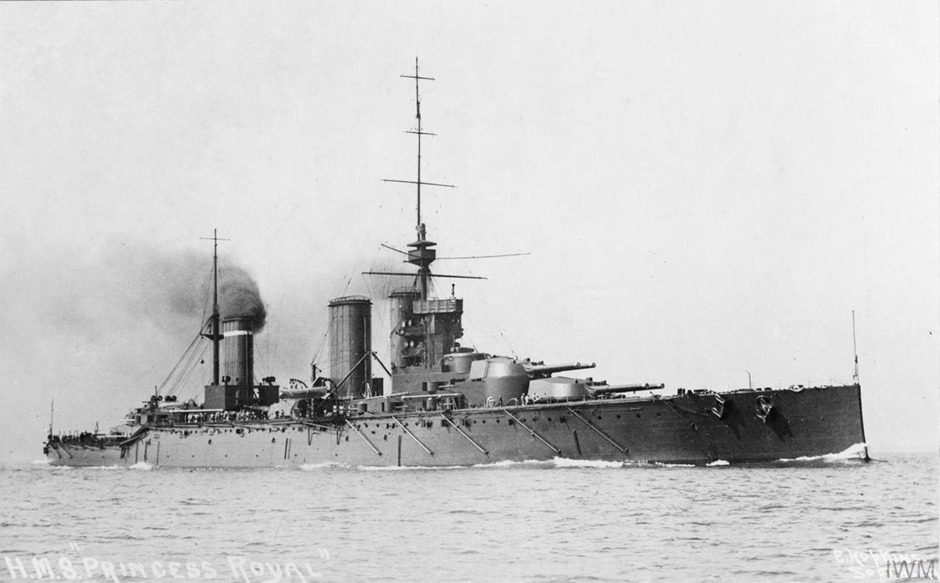
The following month the Princess Royal was detached from the squadron to escort a Canadian troop convoy heading to the UK and was then sent to the Caribbean to help search for Admiral Graf Spee’s squadron that was roaming the east coast of the Americas. The Princess Royal returned home in December.
In January 1915 the squadron saw action again at the Battle of Dogger Bank where Beatty’s battle cruisers went up against a German battle cruiser group commanded by Admiral von Hipper. In this battle Beatty’s flagship, Lion, was badly damaged and he transferred his flag to Princess Royal. Because of confused signals the British force concentrated its firepower on the Blucher which was sunk but the delay in destroying the Blucher allowed the other German ships to escape.
In May 1915 when the HMS Princess Irene exploded Ada’s brother-in-law, Herbert Rogers (the subject of another of my stories) was killed. After that Herbert’s wife, Bertha, Ada’s younger sister, moved in to Ada’s and William’s house with their young son.
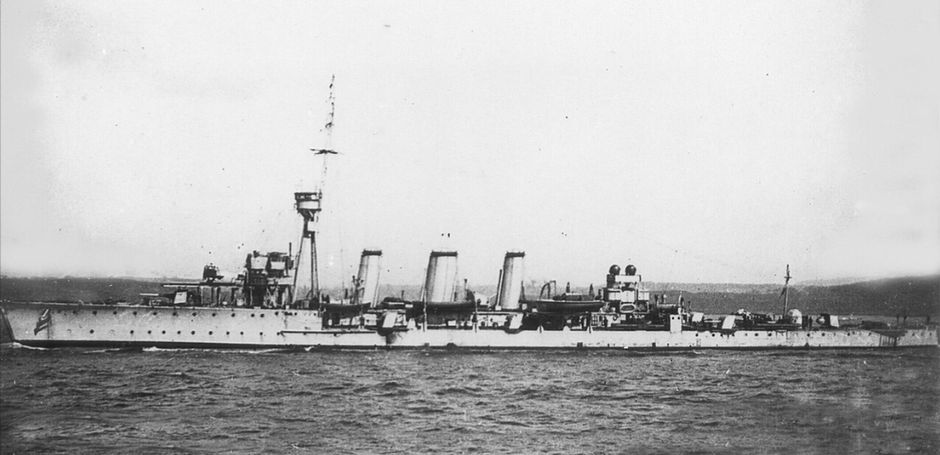
Later in 1915 William was promoted to Leading Seaman and, in September, transferred to the brand new light cruiser HMS Galatea, leader of the 2nd Destroyer Flotilla based out of Harwich. William was to remain with the Galatea until the end of 1917.
Galatea’s first excitement came in May 1916 when she was cruising off the coast of Denmark. They spotted a German Zeppelin LZ32 and together with HMS Phaeton downed the airship with ant-aircraft fire.
The following year Galatea was involved in the most famous naval battle of the war. At the Battle of Jutland, she was the flagship of the 1st Light Cruiser Squadron under Commodore E.S. Alexander-Sinclair. She was the first ship to report the presence of German ships, triggering the battle. Galatea was also the first to receive a hit by the German light cruiser SMS Elbing,
In Dec 1917 William was promoted again, to Petty Officer, and was transferred ashore for another spell at HMS Vernon before taking up a posting to the destroyer HMS Medina engaged in convoy escort duty in the North Atlantic until the end of the war.
The last two years of William’s service were unremarkable, spent either at shore stations or on HMS Ettrick, a fishery protection vessel operating off the coast of Ireland. He was discharged from the Navy on 18 Nov 1923.
At some point after this he moved his family up to Oxfordhire and became a ferryman on the Keen Edge Ferry at Shillingford on the Thames. He was in that role when war broke out in 1939.
With disaster looming in France in June 1940 William re-enlisted in the Navy where there was a huge demand for experienced staff to train the raw recruits who were coming into the service. William was sent to HMS Glendower in Wales, originally a Butlins Holiday Camp, which had been requisitioned by the Navy as a training establishment. The camp specialised in training recruits in use of radar and sonar and in gunnery, particularly anti-aircraft gunnery for defensively armed merchant ships. William was to remain at Glendower for four years until his indefinite release at the end of 1944 when the Battle of the Atlantic had been won and Germany was on its knees.
At some point after the war William and Ada moved back to Hampshire. William died on 15 March 1965 in Fareham

