Nothing except a battle lost can be half so melancholy as a battle won…

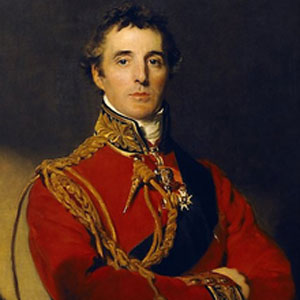
Duke-of-Wellington1Written late in the night after the Battle of Waterloo, Wellington’s words have gone into the annals of military history as one of the most poignant descriptions of the aftermath of battle. In his letter he added, “My heart is broken by the terrible loss I have sustained in my old friends and companions and my poor soldiers.”

Now Wellington was no bleeding heart liberal. Just the opposite, he was known as the Iron Duke, and he never hesitated to flog or hang the soldiers he commanded who he often described as the “scum of the earth”.  But as a diligent commander he was sparing with their lives. He knew he had limited resources and was always strapped for cash and men. Throughout his career he had sought to limit casualties where possible and never shied away from retreat if that was the most prudent course despite one of his other well-known quotes being “The hardest thing of all for a soldier is to retreat.”

At Waterloo he famously ordered the bulk of his force to withdraw beyond the brow of the hill on which they were drawn up and to lie down to minimise the target made by their massed formations. It is said this movement misled Marshal Ney into believing the Allies were retreating and precipitated his disastrous mass cavalry charges that broke helplessly on the formed squares of the redcoats.

Antoine-Fauveau-Cuirass

The effect of small calibre roundshot on metal plate

Yet despite his prudence there was little he could do to protect especially the infantry from the merciless bombardment of the French artillery. More than anything else it was the artillery that was the real killer on the battlefield. With roundshot at distance and case or canister at close range, the guns could destroy whole swathes of men and horses and there were over 500 cannon on the field of Waterloo.

The carnage must have beggared belief. With some 200,000 men and 60,000 horses in action on a battlefield measuring only five square miles it meant the resulting concentration of death and destruction has rarely been equalled in the history of warfare. The average number of casualties per square mile suffered by Wellington’s army during that single day was nearly 2,300, a higher concentration than the British Army suffered at the Battle of the Somme.

Afterwards Wellington said, “I hope to God that I have fought my last battle. It is a bad thing to be always fighting.” And so it turned out. After Waterloo, aged just 46, he never fought another action. Promoted Field Marshal, he became commander in chief of the British Army and Prime Minister.

But there was another side to the stern Iron Duke. Later in life, the Duke once met a little boy, crying by the road. “Come now, that’s no way for a young gentleman to behave. What’s the matter?” he asked.

“I have to go away to school tomorrow,” sobbed the child, “And I’m worried about my pet toad. There’s no-one else to care for it and I shan’t know how it is.”

Keen to ease the little chap’s discomfort, the Duke promised to attend to the matter personally.  After the boy had been at school for just over a week, he received a note: “Field Marshall the Duke of Wellington presents his compliments to Master —- and has the pleasure to inform him that his toad is well.”

Let them eat cake…

AntoninCaremeOkay, the quote is attributed to Marie Antoinette but it was the original “celebrity chef”, Marie-Antoine (known as Antonin) Carême, the culinary genius named in honour of the Queen, who turned the words into reality for Parisian high society. Acknowledged as the father of classical French cuisine, Carême rose literally from the gutters of Paris to be the most celebrated chef of his, or perhaps any, age.

He was born in 1784 to a poor family, perhaps the sixteenth of up to twenty-four children and he was abandoned by his parents on the streets of Paris to fend for himself when he was eight or nine years old. Luckily for him he was taken in to skivvy at a Paris chophouse and there he began to learn the trade of cooking. At 14 he was apprenticed to Sylvain Bailly, a famous patissier and from there he never looked back.

In his two years under Bailly he began to work with the head chef of one of Paris’s most renowned society figures, Charles Maurice de Talleyrand-Perigord and when Talleyrand bought a large country estate in 1804 he hired Carême as his head chef. It is said that Talleyrand set Carême a test, to concoct a year’s worth of menus without repeating a dish and using solely seasonal produce. Carême passed the test easily and was hired.

cakes

Some of Carême’s creations

While working for Talleyrand, Carême also ran his own specialist pastry shop, Patisserie de la Rue de la Paix, which became famous for his beautifully crafted decorative centrepieces made out of nougat, marzipan, sugar and pastry. Even Napoleon commissioned Carême and the master chef created the Emperor’s wedding cake.

After the fall of Napoleon, Carême moved to England for three years where he was the principal chef to the Prince Regent. But the climate in London did not suite him so Carême moved back to Paris where he was hired by Baron Rothschild with whom he remained until he retired in1829. By that time he was paid an annual retainer by the Baron of 8,000 francs (equivalent to about £125,000 today) to cook at a handful of setpiece dinners.

marie-antoine-careme-pastry-designs-architectual1

More of Carême’s creations, inspired by his interest in architecture

From 1829 until his death in 1833, brought on early due to the years of poisoning he had been subjected to cooking over charcoal, he dedicated himself to writing and became one of the most prolific and influential cookery writers.

Not bad for a boy from the gutter.

Madame Bubbles…

veuve clicquot

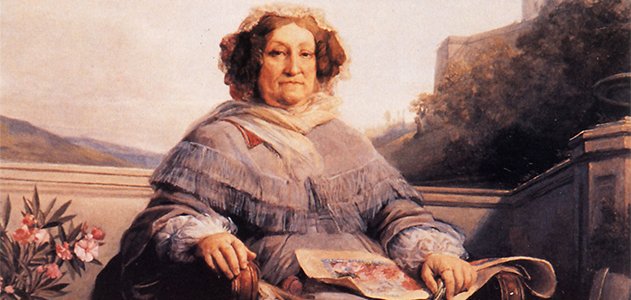
Barbe-Nicole Ponsardin was born in December 1777 and was the daughter of a wealthy textile manufacturer and politician in Reims.  Through her father’s political nouse and careful choosing of sides the family survived the Revolution relatively unscathed and in 1798 Barbe-Nicole married  Francois Clicquot, whose family was active in textiles and wine. The young man was particularly interested in wine, and his new bride joined him in learning the business but they struggled to make it work.

In 1805, Francois Clicquot died suddenly, leaving behind a 27-year-old wife, a young daughter and a failing business. The widow Clicquot, rather than withdrawing into domesticity or finding herself another husband, instead threw herself into the business, focused on wine production and changed the company name to Veuve Clicquot Ponsardin. “Veuve” being the French for “widow”.

veuve-clicquot-labelThe task before her was daunting with the Napoleonic Wars raging across Europe, disrupting trade and flattening national economies. But her father-in-law believed in her and backed her with sufficient finances.

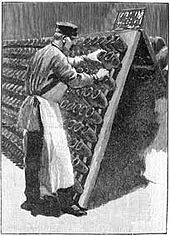
Under her management and her skill with wine, the company enhanced the production of champagne using a novel technique called riddling.

riddling

Riddling

Prior to this invention the second fermentation of wine to create champagne resulted in a very sweet wine with large bubbles and sediment in the bottle from the remains of the yeast used in the fermentation. This residue resulted in the wine being cloudy. Veuve Clicquot’s technique still used the original English technique of adding additional sugar, but after this second fermentation was complete the bottles were held upside down. They were then turned a fraction each day so that the dead yeast would all gather near the cork. This is what became known as remuage (or riddling in English). Once the settling was complete, the wine near the cork was removed and topped up with fresh wine to refill the bottle.

The widow’s commercial breakthrough came in 1814, ironically with the defeat of France by the allied forces ranged against her. She managed to ship her 1811 vintage, regarded as the first truly modern champagne, to St. Petersburg where it was an immediate hit and opened the door to the Russian market which Veuve Clicquot would dominate for the next 50 years. Pushkin, Chekhov and Gogol all praised her champagne.

The company went from strength to strength. By the 1820s Veuve Clicquot was exporting 175,000 bottles of champagne a year. By the time of her death in 1866 the widow’s house was the largest champagne producer in the world. Now the company has a revenue of over one billion pounds a year.

By way of a footnote, in 2010, diver Christian Ekstrom discovered 46 bottles of Veuve Clicquot near the Åland Islands in the Baltic Sea. The bottles had been lost en route to Russia, dated back to 1825-1830 and were likely made by the widow. They were remarkably well preserved due to the dark and cold of the seabed and one of the bottles was auctioned in 2011, fetching €30,000 which was a new record for a bottle of champagne at auction.

auction bottle

The most expensive bottle of champagne in history

One other bottle was chemically analysed and showed some interesting results. The level of sugar was much higher than modern champagne. There were also much higher levels of salt, iron, lead, copper, and arsenic(!) compared with modern vintages. The iron probably came from nails used in the wine barrels, and the lead leached from brass valve fittings of the winemaking equipment. It is believed the arsenic and copper originated from antiquated pesticide applied to the grapes.

Cheers!

A courage and devotion of an age that is no longer ours…

larrey

Dominique-Jean Larrey

At the height of the fighting at the battle of Waterloo in 1815 the Duke of Wellington spotted a surgeon in the French lines working on wounded while under fire. When he was told it was Dominique-Jean Larrey he gave orders for his men not to fire in the doctor’s direction and doffed his hat in salute. When asked by the Duke of Cambridge what he was doing Wellington pointed at Larrey and said, “I salute the courage and devotion of an age that is no longer ours.”

By the end of the Napoleonic wars Larrey, the son of a humble shoemaker, was famous for his medical skill, his innovations in the field of battlefield medicine and his devotion to his patients.

Born in 1766, it was on his father’s death that he went to live with his uncle who was a surgeon. Deciding on a career in medicine he was a medical student in Paris when Revolution erupted in France. Fully believing in the ideals of the Revolution he took part in the storming of the Bastille in 1789.

In the early years of the Revolutionary Wars Larrey served in the Army of the Rhine and it was there that he noted the speed at which horse-drawn artillery could move around the battlefield.

ambulance

Flying ambulance

Convinced that speedy treatment of battlefield wounds was the best way of saving soldiers’ lives he proposed the construction of lightweight carts which could be driven into the thick of the fighting to retrieve wounded and get them to the surgeons as fast as possible.

ambulance1During the next couple of years he developed his design and ideas for the use of what he called his “flying ambulances”. Each vehicle was manned by teams trained in first aid who would perform basic patching up of the wounded before transporting them back to central stations manned by surgeons and their medical staff. There, the injuries were assessed and the patients prioritised based on the nature of their wounds rather than rank, prestige or even nationality. In effect Larrey invented the practice of battlefield triage as we know it now.

In 1797 Bonaparte requested Larrey’s transfer to the Army of Italy and thereafter Larrey was closely associated with the man who was to become First Consul then Emperor.

At the end of the abortive Egyptian campaign when Bonaparte decided to abandon the army and return to France, Larrey was one of the few who Bonaparte selected to accompany him but Larrey declined, insisting that the wounded soldiers left behind needed him more than Bonaparte. Napoleon duly accepted the doctor’s suggestion and Larrey stayed behind. After the surrender of the French army he was finally repatriated to France and immediately promoted and made Chief Surgeon to the Consular Guard.

From 1805 for the next ten years Larrey was constantly on campaign.

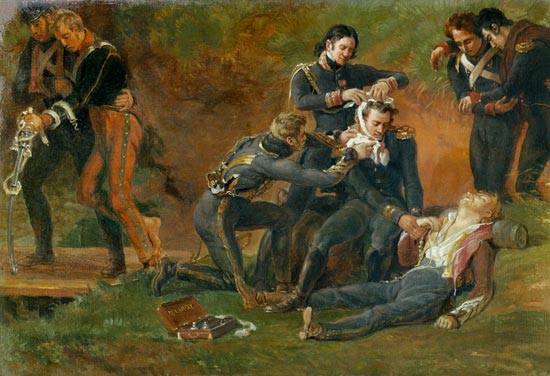
At Eylau in 1807 the Russian attack on the French flank nearly overran Larrey’s field hospital. Refusing appeals to evacuate, he calmly carried on with his operations insisting that he would die with his patients if necessary. It was only the last minute counter-attack by General Lepic’s cavalry that saved the situation and Lepic was only able to ride because of the treatment he had received from Larrey that very morning.

In 1809 during the battle of Aspern-Essling he personally amputated the legs of his close friend Marshal Jean Lannes who had been struck by roundshot. Despite the emotions of performing the procedure on a friend, Larrey carried out the operation impeccably but the wounds became infected and despite his best efforts Lannes died six days later. Larrey hadn’t left his friend’s side for the last three days of his life.

larrey and durand

Larrey treating wounded

Rewards followed for Larrey. He was made Companion of the Legion of Honour and Baron of the Empire. But more important to him was the esteem in which he was held by the soldiery. This was to save his life in Russia in 1812.

On the advance to Moscow the French and their allies fought the Russians at Borodino. The carnage was unbelievable and Larrey estimated he performed over 200 amputations during the battle and in the following 24 hours. But it was on the infamous retreat at the catastrophic crossing of the Beresina where he came closest to death. In a letter to his wife he related how much he owed to the ordinary soldier:

“In truth I owe my survival to the soldiers. [They] helped me to my feet and supported me when, from physical exhaustion, I fell in the snow. Still others shared with me the rations they had. If I approached their bivouac fire they would make room for me and I was even wrapped in straw or their coats. How many generals and senior officers were rebuffed and sent away without pity by their own soldiers! But at the name of Larrey all rose to their feet and welcomed me with a respectful friendship. Anyone but I would have perished at the Beresina when I crossed for the third time at the most dangerous moment [he had crossed repeatedly to try and save his medical equipment from the ambulances which had to be abandoned on the east bank]. But hardly had I been recognised than I was seized by strong hands and passed from one to the other, like a bundle of rags, to the end of the bridge… These signs of the love of the army for me are the greatest rewards I could wish for.”  

Larrey continued to serve through the campaigns of 1813 and 1814 and when Napoleon escaped from Elba in 1815 Larrey came back to serve the Imperial Guard again. At the end of the battle of Waterloo when the French were in full retreat Larrey was cut down by a troop of Prussian lancers and left for dead. When he regained consciousness and tried to head away from the field he was captured by more Prussians.  He was about to be peremptorily shot when the Prussian surgeon recognised him (he had attended some of Larrey’s lectures) and persuaded his commanding officer to spare the French doctor. The Prussian agreed and sent Larrey off to Marshal Blücher’s headquarters where he was recognised and treated with respect having saved the life of the Marshal’s son after the battle of Dresden two years previously.

When Napoleon died he left 100,000 francs to Larrey but it was not his legacy that made Larrey’s heart swell but the words Napoleon had used to describe him in his will,

“The most virtuous man that I have known.”

Dominique-Jean Larrey died on 25 July 1842, three days after the death of Charlotte, his beloved wife of 48 years.

War fever…

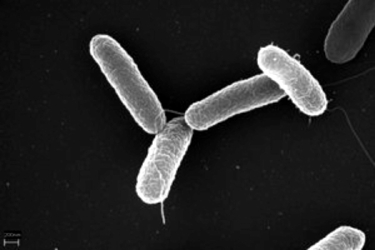
Rickettsia prowazekii

Rickettsia prowazeki bacteria

It isn’t some jingoistic call to arms that I refer to but rather a dispassionate, indiscriminate killer. More terrifying, more sinister and certainly more effective in its kill rate than any cannon shot or sabre, it is Rickettsia prowazeki, the organism that causes typhus, and because of its prevalence on campaign, the disease the common soldier simply called “war fever”.

It isn’t known with any kind of accuracy how many soldiers and civilians were killed in the Napoleonic Wars. A ball-park consensus typically estimates between 2.5 and 3.5 million combatants and perhaps another 1.5 to 2.5 million non-combatants died during the course of the wars. But what is clear is that, in tune with all wars up until the 20th century, the battle casualties were dwarfed by those caused by disease.

One reasonably accurate example to support this comes from the British Army medical services who recorded the deaths of patients in their hospitals in the Peninsula  between 1812 and 1814. Deaths due to wounds were 2,699 whereas deaths due to diseases of various kinds amounted to 13,124.

But perhaps the most pronounced example of the devastating effect of disease on Napoleonic campaigns came in Russia in 1812. Almost since the immediate aftermath of the epic failure of Napoleon’s Russian campaign, the principal blame for the disaster was laid at the door of the weather – “General Frost”. It is true that the winter of 1812 was the harshest for many years but what also seems true is that the campaign was utterly doomed from shortly after it was launched in the early summer.

On 22nd June Napoleon reviewed his massive army gathered on the west bank of the River Nieman and the next day, with great fanfare, they began to cross and launch their offensive into Russian territory. As per usual policy Napoleon’s forces lived off the land during campaign. Unhindered by a cumbersome baggage train this allowed his armies to deploy more flexibly but would only work if the territory they advanced over could support their needs. Inevitably this meant depredations on the local civilian population but this had proved sustainable in central and western Europe. However, Poland and western Russia was another matter. Utter poverty was endemic in these regions and from the start food was in short supply.

And with poverty comes squalor, with squalor comes vermin and with vermin comes disease.

Memoirs by the French soldiers and their allies related the filthy conditions of the villages in Poland and include descriptions of local inhabitants being infested with lice. Within days of crossing the Niemen, soldiers began to develop high fevers and pink rashes on their bodies. Typhus had broken out in the Grande Armée.

Typhus is a particularly dreadful disease spread by human body lice and, of course, where better than the conditions of a military campaign with thousands of sweaty, dirty bodies in close proximity for the disease to reach epidemic proportions.

A louse becomes infected with typhus by taking a blood meal from a fever-ridden human. Once in the louse’s gut, the rickettsiae bacteria reproduce in such enormous numbers that they cause cells in the insect’s gut to rupture. Humans become infected by rubbing or scratching the lice faeces, infected with the rickettsiae bacteria, into their skin or into their mucous membranes.  Once infected, humans experience a high fever that continues for approximately two weeks. Simultaneous symptoms may include severe headaches, bronchial disturbances, and mental confusion. After approximately six days, red eruptions appear on the torso, hands, feet, and face. Mortality is incredibly high under epidemic conditions, nearing 100%.

Just a month into the campaign, Napoleon had lost 80,000 soldiers to typhus and dysentery. Fierce actions were conducted at Smolensk and Valutino but Napoleon failed to secure the battle of annihilation he was intending and the Russians continued to retreat following their customary tactic of giving up space for time. By the end of August Napoleon had lost over 100,000 of his central army and the rate of loss was accelerating as the epidemic grew.

Though Napoleon had the best military medical staff in the world at that time they were powerless to fight a disease they did not understand.  The Russians stood and fought again at Borodino on 7th September. It was a bloody confrontation; the French suffered 30,000 casualties and the Russians lost 50,000 soldiers. However, the Russian army was not destroyed; it retreated again, leaving Moscow open to the French.

When Napoleon entered Moscow one week later he had little more than 100,000 tired, sick men left from his central army group. It was a devastated shell of the army that had crossed the Nieman just three months earlier.

The French would stay in Moscow for just a month. The Russians deliberately set fires that burned three quarters of the city. Though it offered some shelter, there was no food in Moscow, and typhus raged. The Russians refused Napoleon’s overtures to surrender and on 19th October, 95,000 French soldiers began the long retreat back towards the Nieman.

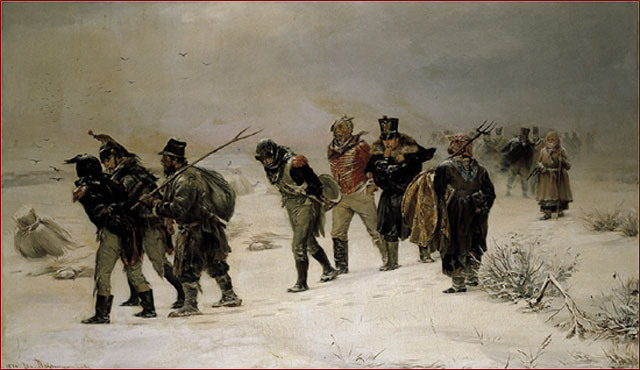
prianishnikov_1812

By the time the first snows fell on 3rd November, the army was already in a desperate state and as the temperature fell like a stone it merely speeded its disintegration. By the time the remnants of the army re-crossed the Nieman in the middle of December there were just 25,000 men left of Napoleon’s original central army group of over 400,000.

On the 20th December, Napoleon reported to the French Senate, “My army has had some losses but this was due to the premature rigours of the season.” Thus he cemented in everyone’s mind the effect of the winter weather on the campaign. In reality his army was destroyed before the first snow fell.

It has been estimated that over 200,000 of them died solely from disease.

Reassuringly however, Napoleon concluded his 29th Bulletin of the Grande Armée, which he published in Paris at the end of the campaign, with the curious sentence: “His Majesty’s health has never been better.”

I bet the relatives of the almost half million casualties of the campaign were so relieved.

Up, up and away…!

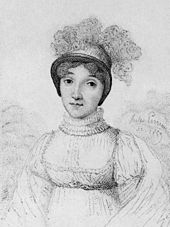
Sophie_BlanchardSophie Blanchard was a provincial lady with a nervous disposition. Ordinary carriage trips frightened her. Yet she was to go on to become the most famous balloonist of the Napoleonic age and the first female professional balloonist in the world.

Sophie couldn’t claim the title of the first woman balloonist. On May 20, 1784, four society ladies had taken a trip on a tethered balloon in Paris. Sophie also wasn’t the first women to ascend in an untethered balloon. Citoyenne Henri had that honour in 1798. However, Sophie was the first woman to pilot her own balloon and the first to make ballooning her career.

Sophie married Jean Pierre Blanchard, the first professional balloonist in the world, and the couple travelled round Europe giving demonstrations of balloon flying. Although Sophie only began to fly in 1804 in an attempt to draw greater audiences and salvage their business which, through poor business acumen, Jean Pierre had brought close to bankruptcy. They hoped the novelty of a female balloonist would untangle their finances and so it proved.

In 1809, Jean Pierre Blanchard died after he fell from his balloon in the Hague following a heart attack. Thereafter, Sophie continued to ascend alone and began to specialise in night flights combining firework displays with her flights with the fireworks launched from her balloon to add to the spectacle.

Napoleon championed Sophie and designated her the “Aeronaut of the Official Festivals,” making her responsible for organizing ballooning displays at festivals and other events.

On May 4, 1814, when Louis XVIII entered Paris after being restored to the French throne, Sophie ascended from the Pont Neuf  in her balloon as part of the celebration.  The King enjoyed her performance so much that he appointed her “Official Aeronaut of the Restoration.”

Sophie’s fame spread throughout Europe and she attracted large crowds to watch her ascents. She even crossed the Alps by balloon, a trip in which icicles formed on her hands and face.

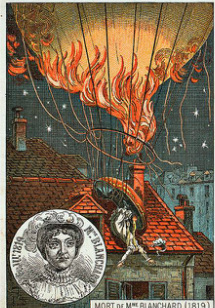
death of sophie blanchard

The death of Sophie Blanchard

On 6th July 1819 she performed her final flight above the Tivoli Gardens in Paris. In particularly windy conditions her fireworks ignited her balloon and it fell from the sky. Hitting the roof of a house in the Rue de Provence Sophie was pitched out of the gondola and fell to her death. She thus achieved her final “first”, being the first female fatality in an aeronautical accident.

Daughter of a soldier, wife of a soldier, mother of a soldier, and the widow of a soldier…

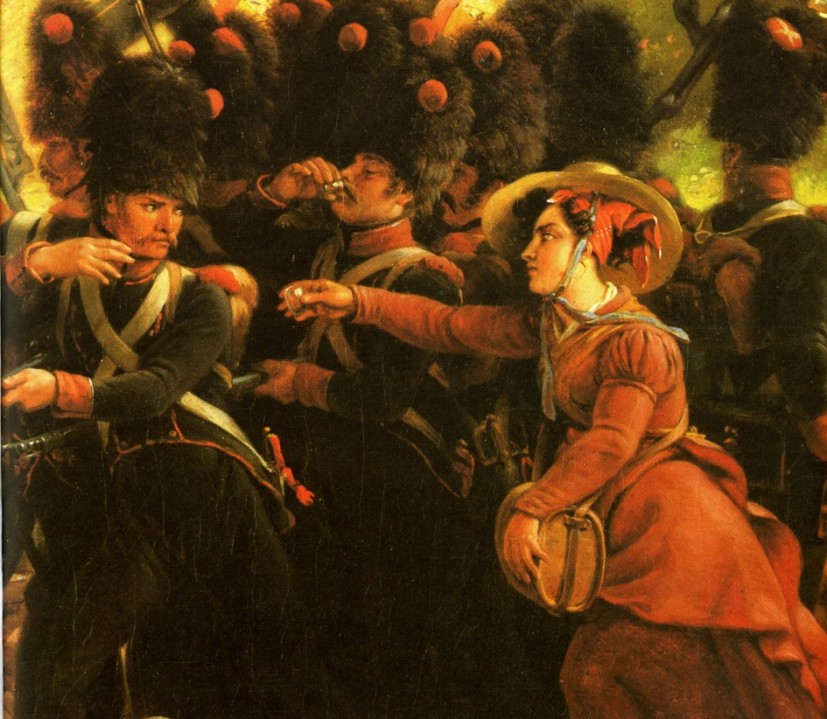
This was the remark of Marie Tête-de-Bois, summing up her own life. She was perhaps the best known vivandière, one of the women who received patents from divisional generals to provide provisions for their men. With their wine, spirits, food and tobacco, their tents provided one of the few havens of comfort and conviviality in the otherwise bleak conditions of military campaigns.

vivandiereTypically they dressed in a modified version of the uniform worn by the unit they were associated with, a cut down tunic worn over the top of heavy wool skirts and sturdy shoes; but their ubiquitous mark of distinction was their canteen strapped over a shoulder.

While some 19th century prints show romanticised images of vivandières as trim and jauntily costumed girls, in reality most of them were probably as hard as nails and about as feminine (Marie was nicknamed Tête-de-Bois because  of her legendary ugliness). The nature of war frequently put them in harm’s way and the rigours of campaign were unforgiving particularly for an army in retreat. The horrors of the war in Spain and in Russia particularly drew no distinction between combatants and non-combatants and camp followers suffered terribly. They had to be tough and take every trial in their stride.

vivandiere 1Catherine Beguin, a vivandière with the 14th Light Regiment once carried her wounded husband for two leagues (about six miles) on her back until she reached the field hospital.

Marie Tête-de-Bois, pregnant at Marengo, gave birth near the battlefield. A passing soldier yelled, “Hey, Marie, you dropped something.” Her son would go on to become a drummer boy at the age of ten (this was common in many regiments), would become an officer and later be made a Knight of the Legion of Honour.

Though the average vivandière may have been a bit of a battleaxe, nevertheless they were often married to a string of NCOs as death claimed one husband after another – for on campaign they were as eligible as any pub landlady 🙂

Catherine BallandThey were brave too as the vivandières were not protected from the dangers of the battlefield.

Catherine Ballard with the 95th Line Regiment, honoured by Lejeune in his painting here, received the Legion of Honour in 1813.

The vivandière of the 63rd Line Regiment was decorated during the Russian campaign of 1812 when she killed a Cossack and saved the life of the commander of the brigade. Elzear Blaze in his memoirs spoke of “the courage of these women which sometimes equalled that of the old grenadiers”.

Inevitably some vivandières came too close to the fighting and became casualties. This was ultimately the fate of Marie. In fighting around Paris in 1814 her husband was killed and she was seriously wounded but she was back by the Hundred Days. At Waterloo she was serving with the 1st Grenadiers of the Guard in her 17th campaign with the army. Around 8pm, near the very end of the day’s fighting, she was killed by a cannonball.

Bonaparte’s close-run thing…

“This battle is lost but there is still time yet to win another.”

Battle of Marengo

Battle of Marengo

It was 5pm on the 14th June 1800 and Napoleon Bonaparte was on the brink of defeat in the vineyards and corn fields of the plain of Scrivia in northern Italy. But his faithful lieutenant, General Louis Desaix, mud splattered and sweating after a frantic ride cross-country, was undaunted, confident that victory could be snatched from the jaws of defeat.

louis Desaix

Louis Desaix

The battle of Marengo, the climax of my novel Bitter Glory, had been underway for ten hours already. Lannes’ and Victor’s divisions had held the line unsupported against the bulk of the Austrian army for almost five hours before they were forced into a fighting retreat eastwards. As they withdrew, the Guard Infantry, sent forward to plug the gap between them had become isolated and had been cut to pieces by Austrian cavalry.

For hour after hour the dogged retreat continued. Though the French divisions held their discipline, Bonaparte knew that only the arrival of Desaix’s force could prevent a disaster. What he had expected to be a battle of annihilation, the total destruction of the Austrian army in front of Alessandria, was turning out to be the destruction of his own force.

Thinking to prevent the Austrians slipping away, Bonaparte had sent Desaix south to cut off any escape route there but the great man had been duped, partly due to false reports provided by a double agent in the service of the enemy. Desaix’s mission was a wild goose chase as the Austrians had no intention of trying to get away. Instead they launched their own attack and by 5pm they thought victory was theirs. Their commanding officer, Field Marshal Melas, with an injured hand, had withdrawn from the field, handing over to subordinates for the mopping up exercise.

Meanwhile, to the east, as Desaix’s men gradually arrived on the battlefield, a hastily improvised attack plan was put into action. Desaix attacked at the head of a fresh infantry brigade. Though he was killed by a shot in the chest almost immediately, his men pressed home the attack. The extended columns of the Austrian infantry were taken completely by surprise and then thrown into confusion and flight by a devastating charge by Kellerman, son of the hero of Valmy, at the head of his dragoons. His charge criss-crossed the Austrian columns creating havoc and when an ammunition carriage exploded behind the now panicked Austrians, they broke and fled.

death of desaix

Death of Desaix

This created a chain reaction of panic and rout in the Austrian army. They had been so convinced that victory was theirs that the sudden reverse was utterly devastating for them. Their morale collapsed. By 6.30pm they were in total retreat with thousands falling prisoner to the now rampant French forces.

When the fighting finally ended due to darkness and exhaustion at around 10pm the French forces were back to the positions they started in that morning and the battlefield was littered with thousands of dead and wounded.

Fifteen years later Wellington would famously describe Waterloo as a “damned close-run thing”, but there have been few battles in history that have seen a change of fortune so dramatic and so decisive as Marengo.

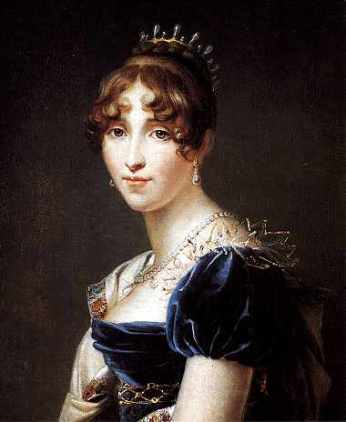
Hortense de Beauharnais

Hortense de beauharnais

Hortense

Hortense Eugènie Cécile de Beauharnais was born on the 10th of April 1783 in Paris, the second child and only daughter of Alexandre and Rose (now better known as Joséphine) de Beauharnais. At the time of her birth, her parent’s marriage was all but over and her premature birth was used by Alexandre’s vindictive mistress, Laure de Longpré, to persuade him that he was most likely not even her father.

From this point onwards the hypocritical Alexandre stoked up his campaign to tarnish his wife’s reputation and she was forced to take up residence in the convent of Panthémont in the Faubourg St Germain, which acted as both a school for aristocratic girls and a refuge for wealthy ladies, who were able to live there unmolested with their children. Things between the couple came to a head in 1785 when Alexandre kidnapped his son Eugène from the convent and Joséphine was forced to legal action to get her boy back. The resulting settlement forced Alexandre to drop his allegations about Hortense’s paternity and her childhood thereafter was pleasant enough with two years spent in Martinique with her mother.

The reason I dwell a little on this is that these events early in Hortense’s life must have influenced her because later in life she was devoted to her mother and readily gave up her own desires to comply with her mother’s wishes.

When Revolution swept through France, Alexandre eventually came under suspicion and, following his failure to defend Mainz during the siege of 1793, he was imprisoned. Joséphine followed him into imprisonment a month later; Hortense and her brother were left in the care of a devoted governess.

Alexandre de Beauharnais was guillotined in July 1794. It looked like Joséphine would follow him but the coup of Thermidor put a stop to the Terror and she was eventually freed in August 1794. Relieved to be alive, Joséphine now threw herself into the fashionable life that had sprung up in Paris after the fall of Robespierre and became a leading light in society thanks to her friendship with Madame Tallien, who had helped to secure her release. With an eye to the political situation she was conscious of the need for a protector and her social standing allowed her to meet many candidates. One particularly caught her attention, an up and coming young general  – Napoléon Bonaparte.

When Joséphine married Napoléon Bonaparte in 1796, Hortense was just shy of her thirteenth birthday. Initially she and her brother were very reserved with respect to their mother’s new husband, but their reticence soon changed to unreserved admiration. Napoléon, for his part, was to act very affectionately towards them. It would turn out in time that his step-children were far more loyal to him than his own siblings.

When she was seventeen, Hortense fell in love with Géraud Duroc, a senior aide to her step-father. She was tall and slender with blonde hair, large blue eyes, a heart-shaped face and fine features; unquestionably a beauty. Napoleon would have allowed a marriage to Duroc, but Josephine, constantly mindful of a need to reinforce her position and her links to the Bonaparte family, had her sights set on a political marriage for her daughter and as a result of her scheming, Hortense was married to Louis Bonaparte on 4 January, 1802.

Louis Bonaparte

Louis Bonaparte

The marriage was not a happy one but the couple had three sons who they confusingly named:

  • Napoléon Louis Charles Bonaparte (10 October 1802 – 5 May 1807)
  • Napoleon Louis Bonaparte (11 October 1804 – 17 March 1831)
  • Charles Louis Napoléon Bonaparte (20 April 1808- 9 January 1873)

In 1806, Napoleon made his brother the King of Holland, and Hortense reluctantly accompanied her husband to The Hague. Though she was pleasantly surprised by the warm welcome she received from the public, she hated her stay there because of her bad, and deteriorating, relationship with Louis. She took up water colour painting and was an accomplished amateur musical composer, supplying the army with rousing marches, including Partant pour la Syrie. She also enjoyed playing games and was even better at billiards than her mother.
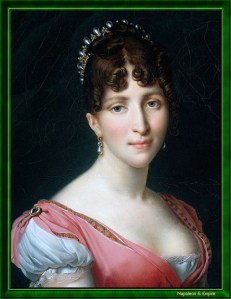
hortense beauharnais

Hortense

When her son died in 1807, Hortense returned to Paris. This tacit separation suited Hortense, and she therefore refused the divorce that Louis wanted, caring little for her own titles and position in the court but looking to her children’s future, a characteristic she had obviously inherited from her mother.

When the marriage of Joséphine and Napoléon came to its inevitable sad end in January 1810, Hortense was on hand to offer support to her devastated mother. Though, both she and her brother made it clear to their stepfather that they would never cease to care about him. Perhaps that was some comfort to him too as he had grown to genuinely love his stepchildren over the years and they never let him down unlike his own family.
Général_Charles_Auguste_Joseph_de_Flahaut

de Flahaut

A few months later, when his Dutch kingdom was taken away from him, Louis remained in Holland, turning to writing and poetry.

This left Hortense free to respond to the romantic overtures of the man whom she had long admired, Colonel Charles Joseph, Comte de Flahaut. He was a sophisticated, handsome man rumoured to be the illegitimate son of Talleyrand. They soon became lovers and, early in 1811 Hortense realised she was pregnant again. Confessing all to Eugène and trusting in the loyalty of her household, she went to Switzerland where she gave birth to a son, Charles Auguste Louis Joseph ( 21 October 1811 – 10 March 1865). The success of the expedition reveals how much Hortense was able to trust her entourage.

She had used poor health to explain her prolonged visit to Switzerland, the journey having been arranged by Adélaïde, mother of de Flahaut. Hortense cleverly disguised her pregnancy (she was, by then, in her sixth month), during the baptism of Napoleon’s son, Napoleon II when she was chosen to be one of the child’s godmothers, an honour she shared with Madame Mère, mother of the Emperor.

During the first Bourbon Restoration of 1814, Hortense had bewitched Tsar Alexander I with her famous charm and. Keen to show his appreciation for the lovely Hortense, Alexander had encouraged the incoming Louis XVIII to show her some favour and give her the title of Duchesse de St Leu.

During the Hundred Days, however, Hortense supported her stepfather and brother-in-law Napoleon. This led to her banishment from France after his final defeat. She traveled in Germany and Italy before purchasing the Château of Arenenberg in the Swiss canton of Thurgau in 1817. Arenenberg became the centre of a small court, a new Malmaison where, accompanied by faithful retainers, Hortense sang, painted and charmed her guests, from Madame Récamier to Alexandre Dumas.
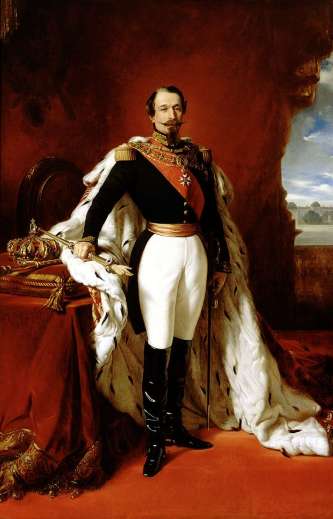
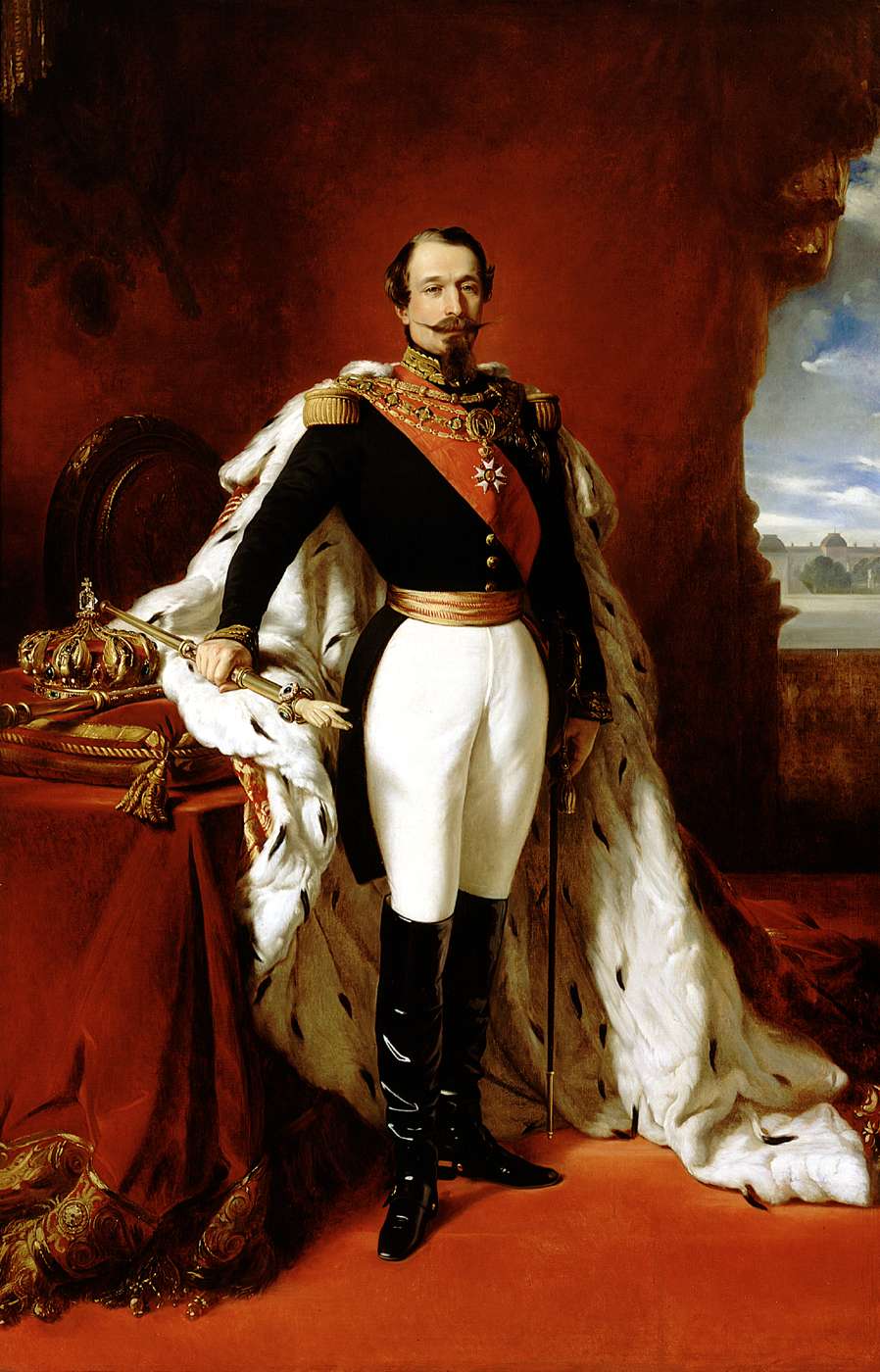
Napoleon III

Napoleon III

In 1837, Hortense then fell ill when her surviving son, Louis-Napoléon, was in the USA. He returned to Arenenberg just in time for his mother to die in his arms on 5 October at the age of fifty-four. She is buried next to her mother Joséphine in the Saint-Pierre-Saint-Paul church in Rueil-Malmaison.

Her husband, Louis Bonaparte survived her by nine years, eventually dying in July 1846. Their youngest son would become Napoleon III in 1852. He in turn would make his half-brother, the son of Hortense and de Flahaut, the Duke of Morny.

Charismatic, courageous, contradictory…. and the ancestor of a shape-shifter.

muratJoachim Murat, perhaps the most easily recognised character with his curly locks and flamboyant uniforms, came from humble origins like many of the brightest stars of the Napoleonic age, became King of Naples and died in front of a firing squad.

An early confederate of Napoleon, it was Murat who provided the guns for the famous “whiff of grapeshot” episode in Paris when the young general Bonaparte helped suppress the Royalist rising of 13 Vendémiaire (1795).

After promotion to lead Napoleon’s cavalry in Italy (1796) and then in Egypt (1798) where he cemented his reputation as a skilled and vigorous cavalry commander, he was included as one of the small retinue Bonaparte brought back with him from the Orient. His pivotal role in supporting Bonaparte during the coup of 18 Brumaire tied him closer to the First Consul and his marriage to Caroline Bonaparte at the beginning of 1800 brought him into the great man’s family circle.

His handling of the French cavalry through the Marengo campaign won him more honours and, with his reputation and his marriage to Caroline Bonaparte, it was a certainty he would be named one of the first marshals in 1804.

More success followed in the Austerlitz campaign of 1805 and by now Joachim Murat was feted as one of the most dashing cavalry commanders in an era of beau sabreurs.

murat at jena

Jena

At Jena, the following year he again led the cavalry with great élan. The painting of him leading a charge during the battle, typically hatless, and armed with nothing more than a riding crop epitomises the dash of the flamboyant leader. But there was more to Murat than battlefield valour. His ruthless pursuit of the Prussian army after Jena-Auerstadt turned their defeat into utter disaster.

But the Eylau campaign of the following winter would prove to be the high point of Murat’s military career. On a freezing February day in 1807 Napoleon was facing defeat at the hands of the Russians, his centre collapsing under the pressure of the Russian assault. He turned to Murat to save the situation and with typical flair he launched the entire cavalry reserve into a massive attack on the Russian formation.

eylau

Eylau

The famed “charge of the 80 squadrons”, fully 11,000 men in two columns crashed through the Russian formations, reformed a single massive column to their rear and drove through them again. The charge cost the French cavalry almost 1500 casualties but they devastated the Russian centre and bought vital time for the French infantry to reform and stabilise the situation.

In 1808 Napoleon offered Murat the crown of Naples and much to everyone’s surprise the commoner proved to be a conscientious monarch introducing civil reforms and reorganisation of the army.

It was four years before his brother-in-law called upon Murat’s services again; this time to lead the cavalry in the ill-fated Russian campaign of 1812. During the six-month campaign, Murat would constantly be in contact with the Russian armies and at the Battle of Borodino, he charged at the Russian guns at the head of 15,000 horsemen.

During the retreat, when Napoleon hastened back to Paris, Murat was left in command of the Grande Armée but he did not want the command and his nerve failed him. Fearful for his kingdom, he lost his head, abandoned the army and fled back to Naples. His divided loyalties from this point seem to become more and more confused.

He asked for Napoleon’s forgiveness for abandoning his post in 1812 and returned to command the Army of the South in 1813, but after the defeat at Leipzig that year he once more fled back to Naples and began to make independent approaches to the allies and signed a treaty with the Austrians.

However, during the Hundred Days he realized that the European powers intended to remove him and return the Kingdoms of Naples and Sicily to their former rulers. At this Murat deserted his new allies and moved north to fight against the Austrians to try and strengthen his rule in Italy through military means but he was defeated at the Battle of Tolentino (2–3 May 1815).

Desperate now, with barely a thousand men he gambled everything on trying to foment unrest in Calabria as a means of regaining control in Naples but the attempt was shambolic. Forces of Ferdinand IV, the former and newly restored King of Naples, arrested Murat at the port of Pizzo.

Murat was tried for treason and sentenced to death. Brave, flamboyant and vain to the end, he took command of his own firing squad. He stood without a blindfold and gave the orders himself with the famous command:

Soldiers! Do your duty! Straight to the heart but spare the face. Fire!

odo

René Auberjonois

Joachim Murat had four children with his wife, Caroline. One of their descendants is their great-great-great-grandson actor René Murat Auberjonois. He has played many roles over the years but my favourite was as Odo, the shape-shifter in Star Trek: Deep Space Nine.

You couldn’t make this stuff up you know!